Showing posts with label Art History. Show all posts

Thursday, July 2, 2020

Elementary Art Enrichment Ideas

When we started our Continuous Learning Plan, Kansas' response to Covid-19, it was decided that elementary specials would be offered as enrichment. Music and PE had two different Zoom sessions a week for PK-2 and 3-6 but I got permission to just do one for all elementary and to use Facebook live. I think it worked better for me with demonstrating (not that I was flawless) than Zoom would have. Why did I ask for one session? Well, besides that I had scheduled Zoom sessions with my middle and high school classes on the same day, I knew that I could present the same ideas and tell how younger and older kids could participate. I also know that with my own children, if the older kid is doing an activity, the younger kids want to do the same thing. All in all, it worked out pretty well.

Here are the themes I used for each week:
Week 1: Color
In the first week I talked about primary and secondary colors and how to mix them then we made a found object color wheel for the #colorwheelchallenge!
Does anyone else have trouble when downloading images from the Canva app? Sometimes I have to do a screenshot to avoid distortions like in the graphic above.

Week 2: The Creatrilogy
Peter H. Reynolds gave permission for teachers to read his books to our classes and since I'm a big fan, I read The Dot, Ish, and Sky Color from the Creatrilogy box set. Suggested activities were...
The Dot: Make dot artwork!
Ish: Draw ishly- use a marker so you can't erase and embrace mistakes!
Sky Color: Observe the sky and paint what you see. Maybe even observe the sky at different times of day or different days of the week. Watercolor demo.

Week 3: Zoos and Aquariums
Have you seen all the zoos and aquariums that were offering virtual field trips and animal talks during social distancing? I showed 4 project ideas inspired by specific zoos or aquariums- a porcupine from the Elmwood Park Zoo, a jellyfish from the Monterrey Bay Aquarium, Fiona the Hippo from the Cincinnati Zoo, and a giant panda from the Smithsonian National Zoo. Check it out!


Week 4: Earth Week
Goldsworthy-inspired nature artwork, Patrick Dougherty-inspired stick art, nature faces, nature fairies, and stick weaving. I love nature art!
Here is the doc with the activities I suggested. Feel free to make a copy so you can edit!

Week 5: Fauvism
I thought of Matisse's Open Window as soon as I knew we would be working from home. I wanted to talk to students about looking around them and how we all see different things out their windows. I said they could draw from observation what they see out their window or even what they would like to see! I went ahead and threw in some more art history and talked about setting up a colorful still life to observe.
Here is the doc I shared!


Week 6: Art Outside
This was my worst week! I paid attention to the temperature in the forecast but not the wind speed. And I live in Kansas! I tried to show using toys to draw shadows and doing texture rubbings but it was so windy that after 5 or 10 minutes I told the students watching it was a good thing they already knew I wasn't perfect and gave up.

Week 7: 2D and 3D
I couldn't really decide what to do for the last week so I asked on my facebook page what the students wanted. A first grader told her mom it would be "life changing" (LOL) if I would show how to draw 3D shapes since they were doing that in 1st grade math. We talked about the differences between 2D shapes and 3D forms (in art we have more specific vocabulary) and then I showed how to draw cubes, cylinders, and cones. I ended by showing how to do 1 point perspective letters since that is usually a hit with upper elementary students.


Wednesday, March 18, 2020

Graphic Design + Ceramics

In my school, my graphic  design course functinos like an Art 1. It is not difficult to hit all the competencies while incorporating traditional art media with digital media. This year I've been conscious about pairing a digital project with each traditional media assignment. There were 2 parts to the introduction to ceramics, designed to cover techniques that the students would be able to pull from in future assignments with more choices. The first assignment was to make a cylinder which could function as a cup or a mug. This assignment covered slab building, pottery, art history, and surface design.
I started wondering about the history of graphic design in ceramics and when I searched, I found a wonderful resource, Guity Novin's a History of Graphic Design, and chapter 12 is Graphic Design in Ceramics. Bingo! Chapter 13 is on Native American Pottery so I showed some of those examples as well. I'm just pretty pumped to know about this resource!

Here is the slides presentation I showed the students so that I could group images by technique:
After the presentation, I demonstrated a variety of surface design techniques that I asked students to take notes on- sgraffito, underglaze, mishima, slip trailing, carving, and stamping. On the note sheet, the students wrote about which technique(s) they would like to try and then were able to sketch their idea.
The students had the rest of the 1st class to plan then 2-3 classes to construct their cylinders and complete the designs. I demonstrated pulling handles for anyone who was interested.

The design on the left used carving and underglazing. The cup on the right used carving, sgraffito, and mishima with the same repeated pattern.
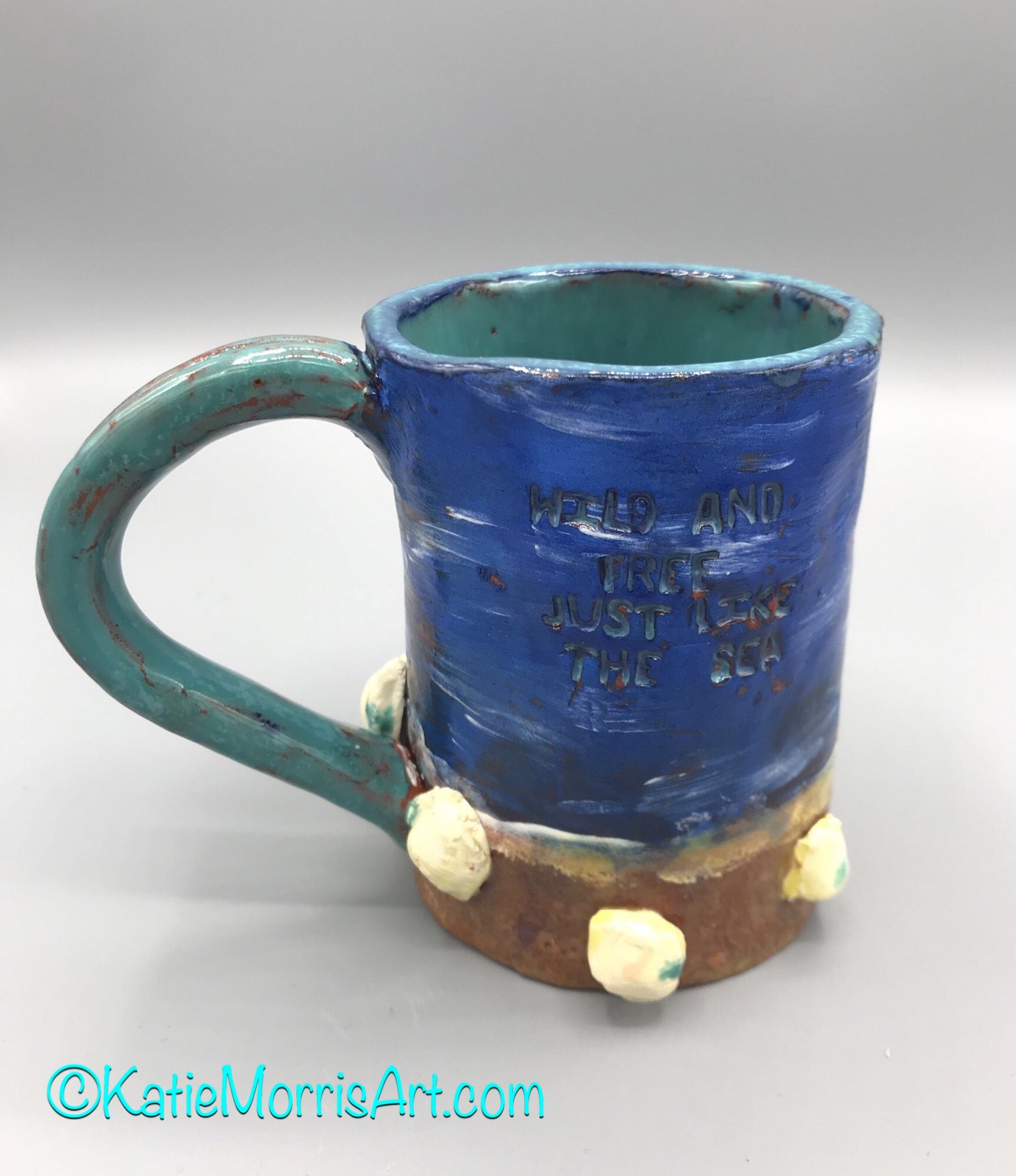
This student incorporated a favorite quote in her ocean-themed mug.
Some inspiration from the Great Wave!

After the cylinders were complete, the students started on the digital part- designing a magazine cover that featured their cups.  
1. Students watched a video that broke down a magazine cover into parts and completed a worksheet I made to label them.
2. They wrote an analysis of a magazine cover they looked up.
3. Students photographed their cups.
4. Adobe Photoshop was used to create the magazine covers. (It was a quick assignment so I didn't want to tackle introducing new software.)


Here are some of the magazine designs

Sunday, March 15, 2020

Viewing Virtual Art- Free Online Resource for Art Teachers

While preparing for online instruction during the Covid-19 pandemic I remembered a slides presentation and questions I put together to hit one of the 7th grade visual arts standards and tweaked it to include taking a virtual tour of an art museum. I may end up using it with my high school students as well as middle school.
Feel free to use as is or to go to file, make a copy, so that you can have your own version to edit.


And here are some really simple questions that I plan to post in Google Classroom for students to answer: https://docs.google.com/document/d/1Metlz63IXyED9pA96ak01vRonv3_EMGAHCIa3VV5h-E/edit?usp=sharing

Thursday, May 16, 2019

Highland Art Day & Sidewalk Chalk Mural

Highland Community College hosts a high school art day each spring and it is an event to which I enjoy taking students. It is close to our league art competition so I usually only take a handful of students. This year we had the 3 seniors who had been for a couple of years and we chose a couple underclassmen so they could learn the ropes and be ready to continue the tradition.

Attending the art day is a good experience because it exposes the students to a big variety of artwork from schools of all sizes. The quality of the work is always impressive and it shows the students what is possible! 

While the show is being judged there are a variety of on-site competitions happening. My students' favorite is always the sidewalk chalk competition with the them of art history with a modern twist.

When brainstorming in the days leading up to the competition, one of the students joked about doing a My Little Pony parody. I told them the first horse painting that comes to mind for me is Napoleon Crossing the Alps. What started as a joke ended up being their idea!


It was starting to sprinkle toward the end so it got a bit rushed but I thought they did a nice job and it was such a fun idea!
We were also thrilled to receive 2 honorable mentions in the art show. The first year I took students was the first year that every school in attendance received an award so an honorable mention is nothing to scoff at. 

Thursday, May 24, 2018

Courbet's Realism: TAB Art History

I love art history. I really, truly do. So often art teachers fall into the trap of thinking students need to imitate an artist's style or a famous piece in order to show a connection. I've done this at times in the past, but what I most like to do is look for the BIG IDEA with the artist's work, and move forward from there.

I graduated from the University of Nebraska at Kearney's online Master's program in Art Education in 2016. I really enjoyed all the coursework and how I was able to make the work I was doing in the classes fit my teaching style. When I took the art history class, my goal was to create the lessons inspired by the unit we'd covered fit in with my TAB-Choice teaching. Some previous examples I've shared were American Regionalism & Contemporary Communities and Monet & Impressionism: Drawing from Memory v. Drawing from Life, which became part of our drawing boot camp. Courbet was introduced on Art History Thursday so students had time to absorb his ideas of what is REAL and to take photos from their own lives before jumping in to a studio project the following week.


The most important idea I wanted students to get is that their own lives are worthy of representation in their artwork! You can see the full lesson plan on the smARTteacher.

We had lots of representations of pets, places that are meaningful, friends, and even favorite candies. I love the range of subject matter created!


Sunday, April 22, 2018

Franz Marc Discussion for National Standards

Last year I developed a one day lesson at the beginning of a unit on color to knock out several of the Respond and Connect National Visual Arts Standards for 7th grade. I wanted to choose an image with a subject that was familiar to the students in my rural school, but presented in a way they might not be familiar with- many of my students are very concrete in their views on art and prefer realism. Franz Marc was a good choice with the bright colors in his German Expressionist paintings of horses and cows- animals my farm living students see on a daily basis.

We started with a Visual Thinking Strategies style discussion and then moved into questions specifically connecting to the standards. 


You can get the complete lesson plan on The smARTteacher!

Monday, April 2, 2018

Digital Op Art

I can't believe I haven't posted this project before! I tried it for the first time with my Computer Graphics class this year and it was a keeper. We covered art history, graphic design, and practiced some new skills in photoshop.
When I show the first slide without the Op Art title, I ask the students if they know what that style of artwork is called or if it reminds them of anything to gauge their prior knowledge. We talk about the "mother" and "father" of Op Art and what we can learn to apply to graphic design.


Next, I demonstrate some techniques in photoshop that the students can try out but ultimately they choose what style of Op Art they want to use. We talk about color combinations, grid/ruler tools, gradient tools, distortion filters, etc.
The technique that the most students want to use is to put text into their Op Art. I recorded a quick video this afternoon of the steps we use. I obviously need to practice screen recording since I flubbed the beginning and end, but at least it will be handy to direct students to that video when they've forgotten a step!


Here are some of the student examples!