Showing posts with label Design. Show all posts

Tuesday, June 4, 2013

CYOA- Clothing and Textile Design

In my last post, I described how my 5th grade students were choosing an area of Fibers to explore (Choose Your Own Adventure). The options were weaving, quilting, and clothing/textile design. There were many options within each of the three categories. Weaving was by far the most popular choice, but I did have quite a few takers on clothing and textile design.
One option, was the clothesline project I've taught a few times. Students paint a sky background then learn to cut and manipulate real fabric to design miniature clothes. You can read about the project on previous blog posts here and here or read the article I wrote for Arts & Activities magazine last December here.
You'll notice a couple differences between this batch of clothes on a clothesline and those from previous years. First, there is a lot more variety in the skies. When I taught the lesson before, I demonstrated how I like to paint clouds and put out the same paint colors at each table. This year since the students had more choices, those working on similar projects sat near each other and together asked me for the certain colors they wanted. It didn't take too long to dispense the paint, and if my pumps weren't prone to clogging and spraying, I would have let the students get their own paint. The second difference is that the overall level of craftsmanship might have been a little lower. Partly because a few, not all, of the girls were more interested in talking and partly because the students were working more independently and making their own choices.
 Another option within clothing and textile design was to create a fabric design on paper, with the idea that it would be pushed further. This option was a little disappointing. I think about 5 students chose this option and they had no sense of urgency. The stamps were created by cutting out foam shapes and gluing on to small pieces of cardboard. I told them that their stamps needed to be finished in the first class period so they would be able to print in the second. Only one student finished creating her stamps the first day and I think she forgot where she put them and had to start over! The other students didn't finish gluing until half way through the second class so they used their extra time to create a second stamp so that they could print in a pattern on the third day. I think what was most frustrating to me is that I know the students were capable of more. I did a stamp making lesson with 2nd grade and even with my Kindergarten students at the same time and the younger students seemed to work harder. I did feel a little better on the last day to see the 5th graders who made stamps at least adding interest with multiple colors. The stamped pattern above is the only one I ended up with a photo of. There were a couple girls adding multiple colors to one stamp to highlight certain shapes and if they had finished, it would have been really cool.
The Choose Your Own Adventure lesson was an experiment. I'm wanting to transition to Teaching for Artistic Behavior but I may have to use a modified approach. I won't know for sure until I get a chance to talk to my principals and until we get our new district standards written. I'm thinking that CYOA could be a happy medium. If it would be a requirement that, for example, students at a certain grade level complete a weaving project, I could whip out menus and the students could still have several choices within that requirement.

Tuesday, July 10, 2012

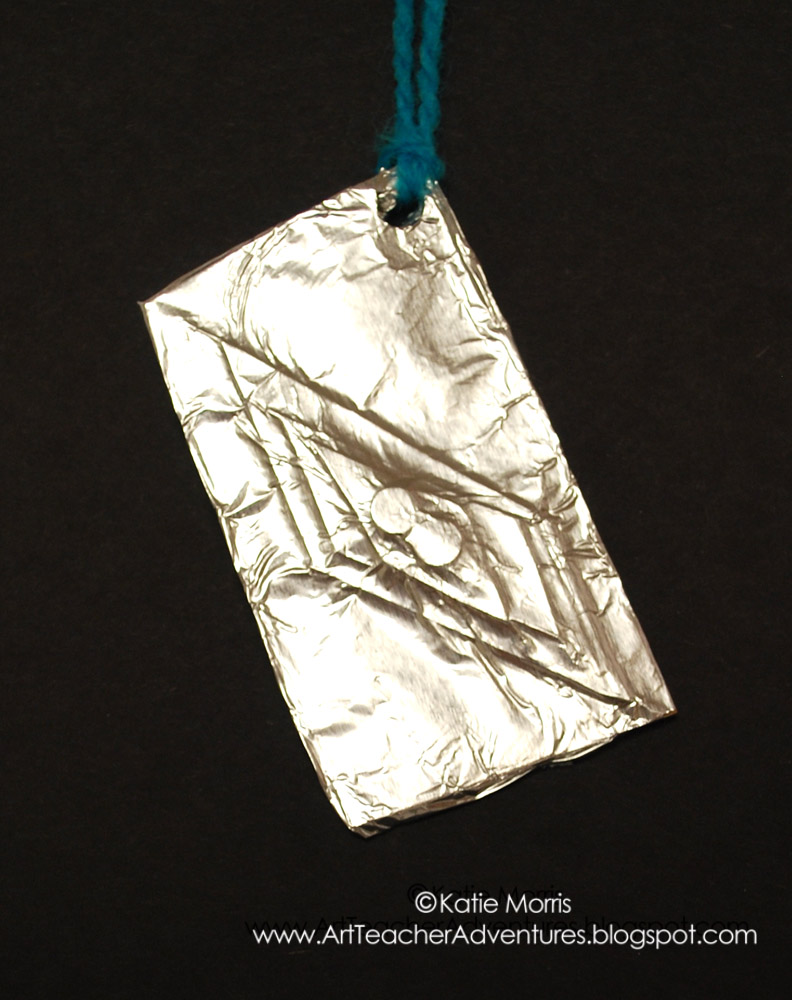
5th Grade Faux Metal Pendants

The end of the school year almost always leaves me with an uneven schedule- depending on the grade level and day of the week and if we've had to reschedule for field trips/assemblies/field day, etc., there is usually a need for some one class period projects. This is the first jewelry project I've ever taught at the elementary level and the students were SO PUMPED! They got to design and create a piece of jewelry and wear it home the very same day.
Last year I tried out a bas relief sculpture lesson where the students cut and layered cereal box cardboard, covered with foil, and embossed. None of us were super into that lesson, but I couldn't get the idea of shrinking it down into jewelry out of my head. We can pretend they are sweat soldered pendants. :)

To introduce the lesson, we talked about why people wear jewelry and covered: fashion, status (rich, royalty, etc.), symbol (wedding ring), safety/protection (medical alert, St.Christopher's medal, etc.) and probably a few other categories that I could tell you had I written this in May instead of July. We looked at a few photos of jewelry online before I launched into a really quick description of relief sculpture, a basic demo, then the students got right to work. I had precut squares and rectangles all around 2 inches in size for the base, then had scraps from lots of other cereal boxes that the students used to make their layered designs. Before covering with a piece of foil, the students had to decide how their pendant would hang and punch a hole. After embossing, the students chose a piece of yarn and started modeling. Some early finishers were eager to make another piece right away.
 This worked pretty well as a 40 minute project, but I would love to stretch this to 2 class periods to spend more time on history and design. I think most students would benefit from making a few thumbnail sketches and talking about which design is strongest before beginning construction.

Wednesday, July 4, 2012

3rd Grade Clay- The Pot That Juan Built


I've taught the same clay lesson for 3rd grade each year- the students hand-build pots with a slab base and coil sides based on the book The Pot That Juan Built. I demonstrate then read the book to the students while they work. (It's my quietest 3rd grade class of the year!) In the second class period when the pots are dry, the students use tempera cakes to paint. The last 2 years, I have just let the students have at it with no direction on colors. This year, we used Aesthetic Scanning to discuss some photos of Juan Quezada's pottery (seen here and here). The students noticed how he typically only uses 2 or 3 colors in the pottery and has lots of little details added with lines. So this year, the students could choose 2 colors of tempera cakes, then I put out liquid black tempera and little tiny brushes so they could add designs on top of their colored base. I like the pottery both ways but overall, they look more finished this way. (You can see a few photos from last year's project here.)
When we make attachments in clay, we use the "4S" method: score, slip, squish, and smooth. I also like this because my older kids use "4S" lines: straight, silent, still, smiling.


We use air dry clay because we don't have access to a kiln. You can read my tips for teaching elementary Art without a kiln here: http://artteacheradventures.blogspot.com/2012/01/tips-for-teaching-elementary-ceramics.htmlhttp://artteacheradventures.blogspot.com/2012/01/tips-for-teaching-elementary-ceramics.html and add your own tip in the comments!

Friday, July 1, 2011

6th Grade Aboriginal-Inspired Artwork


So you might be thinking "Wait a minute, Aboriginal Art is from Australia and I don't think elephants are native to that country!" And you would be right.  I wanted this to be a multicultural lesson and in order for it to truly be MULTIcultural, it can't be all about one culture.  (Thank you, Dr.Grove!) So, we learned about Aboriginal Art and culture and used that for inspiration to create artwork featuring THEIR favorite animal that may or may not be Australian.   This project was voted the favorite of last year's 6th grade students so it was a repeat.


Introduction: I had prints of Aboriginal artwork on the tables when students entered the room.* I asked the students to look at the artwork and make an educated guess as to where the artists lived.  After several guesses, someone said Australia so I went into my introduction of Aboriginal people and artwork.  We also covered the awesome vocabulary word of "indigenous" and split Aboriginal into Ab-ORIGINAL to help the students remember.  To make it hit home, we discussed how Native Americans are indigenous to the United States.  I won't type a script of my presentation (I have enough trouble keeping things brief) but I will tell you that most of my information came from http://www.aboriginalartonline.com/index.php.
 After that, we went through the Elements of Art starting with the elements the students thought were most important in the artwork we looked at.  We don't have the time to go so deep in discussion with every lesson but I think it's really good to do at least once in a while!  I introduced the project and modeled drawing an animal in a style inspired by Aboriginal artwork.


This is the process we used for the paintings:
  1. Pick an animal to work on- your favorite animal or just on you want draw.  If you don't have an idea, consider a fish, snake, or turtle.
  2. Figure out the best angle to draw the animal from- the simplest view that still gives enough information to identify the animal.
  3. Draw a simplified/stylized outline of your animal on your paper. (We used a pack of multicultural construction paper.)
  4. Use lines and shapes similar to those in the Aboriginal artwork to divide the body of your animal into sections.
  5. Include at least three symbols somewhere in your design.  This could be in the negative space around the animal or in the body.  They could be traditional symbols from Aboriginal artwork or made up.  The symbols could go together to tell a story or just be symbols that you like the design of. **
  6. Trace the lines and shapes with a "skinny" sharpie.
  7. Use tempera paint to fill in the sections of the body and symbols with a solid color- red, yellow blue, black, or white.  (We discussed limited color palettes and reviewed primary and neutral colors.  I was mean and did not let them mix colors this time.)
  8. Use the end of your paintbrush to apply dots of paint to create designs in the negative space around the animal.  I recommended patches of one color over the "confetti" effect.  I also suggested a border  of one solid color to outline the animal and moving around the paper as they worked so if they ran out of time, it would still be balanced.
**One of my students did something really cool with his artwork.  He drew a dog for his animal and created symbols that meant he was the guardian of the home.


Last year this was a two (40-minute) class period project.  I gave the students three class periods and still had lots not totally finish.  Some came in during their lunch recess to work on it.  I'm convinced that some students just would not finish even if I gave them ANOTHER class.  The funniest thing to me about this project was my students who are known as being the "good" artists kind of freaked out!  It was almost like if they couldn't draw it realistically, they didn't want to try.  


Finished paintings:


Thursday, April 1, 2010

Mural Design

I probably mentioned before (I talk so much I can't remember who I've told what and what I've written) that I got a grant last fall to paint a mural at school with my 4th-6th grade students.  The students each created a design that was turned in to me (some worked with partners and this was not my brightest idea).  I photographed the artwork, sorted it, and came up with three designs.  Yesterday I finally got "THE" design finalized!  I pulled ideas from different students' artwork and came up with a design that incorporates several of their ideas.  It was a lot harder than I thought to come up with a design.  Probably because I didn't want to limit the students to a strict theme when they were drawing, just told them to make whatever they would like to see as a school mural. 

Now I need to make my shopping list and transfer the drawing to the wall.  Painting will start in two weeks and will hopefully be finished in two weeks- (4 days, one 40-minute period for each class.)  I figure if there are small touch-ups left to do, I'll just finish it.  Getting pretty excited!

You can check out the students' designs in our Artsonia gallery.

Tuesday, March 23, 2010

Doodle 4 Google

I think that Doodle 4 Google is a really fun project.  I decided to do the project after reading about it on Eric Carle's blog.  The project was good design practice and a lot of fun.  Here is the official informative link: http://www.google.com/doodle4google/
Welcome to Doodle 4 Google, a competition where we invite K-12 students to work their artistic will upon our homepage logo. At Google we believe in thinking big and dreaming big, so this year we're inviting U.S. kids to exercise their creative imaginations around the theme, "If I Could Do Anything, I Would …"
Here are 3 of my 6 final entries along with the statement the students wrote explaining how their drawing fits the theme.  (Each school can enter 6 designs.)

If I could do anything I would make the world a more charitable place. I will try to set examples in helping someone in need. I will raise money to help out people and animals in need.
If I could do anything I would… Game it up with Google. By playing video games, you gain knowledge and become smarter. There are lots of games- educational games, sporting games, and games that teach you patience, at least that is what Mom says. Games are great for learning!
If I could do anything I would learn about my state. I’ve just moved from Arizona this year. Since I’ll be living in Kansas I wanted to learn more about the state facts.
G= Barred Tiger Salamander
O= Sunflower
O= Ornate Box(ing) Turtle
G= Cowboy
L= Cottonwood Tree
E= Wheat