Showing posts with label CHW. Show all posts

Saturday, December 27, 2014

CYOA India Wrap Up

I have some random photos of student work that didn't fit into other posts hat I really want to show you, so here's the wrap up of students' choice based Indian culture projects.
The peacock print above turned out really cool. We liked the three colors together so decided to mount them on a large piece of black construction paper.
One of the starting points was Indian "miniature" paintings. Miniature paintings, as the name implies, were small scale. They sometimes depicted scenes of royal life or told stories. This reminded some students of fairy tales, which according to some claims originated in India. This 4th grader wanted to make a drawing of a princess that looked like she belonged in a fairy tale.
This drawing was inspired by the patterns of mehndi and Warli tribal art.
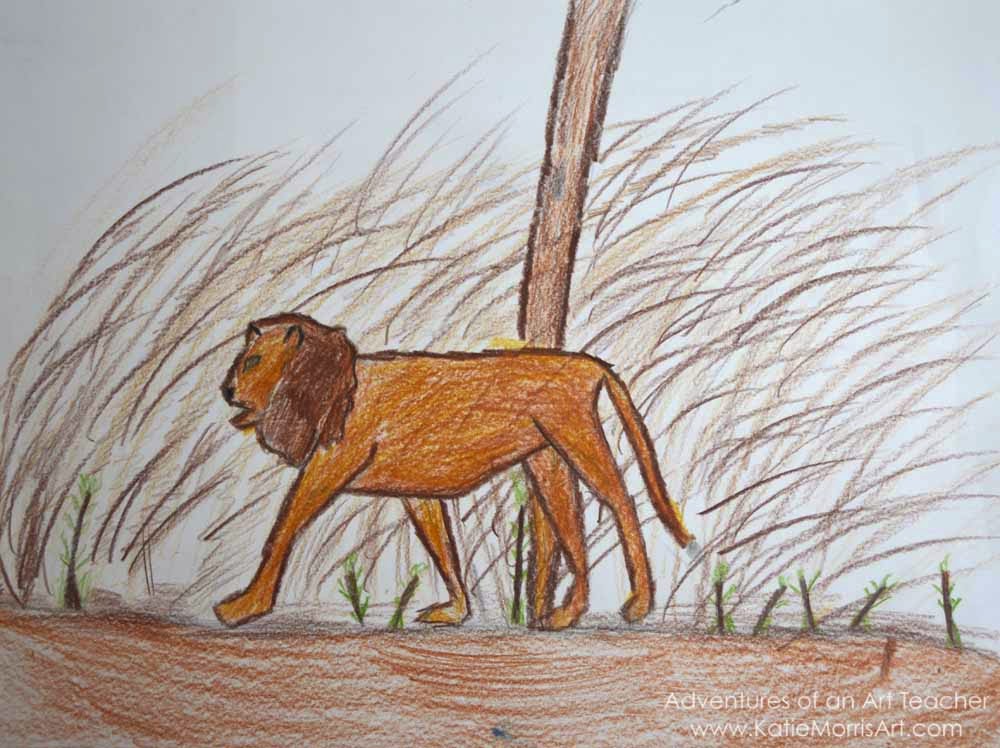
One of my 5th grade boys wanted to draw a Bengal Tiger but add patterns. He really explored what he could do with oil pastels and mixed in colored pencils for some the patterns. Though some students were reminded of King Tut's mask and thought it looked more Egyptian than Indian, we were all pleased with the result.
One of my 6th graders who works very methodically spent many class periods on this project. I knew his work habits so suggested that he draw half of the Taj Mahal as I offered to show him how to transfer the drawing to the other half of the paper. I was so glad that he got something completed!

Wednesday, December 17, 2014

CHW India: Animals

Indian animals were one of the starting points for my 4th-6th graders' Cultural Heritage Week projects this year. India has some really beautiful, interesting animals. On my "choose your own adventure" bulletin board, one section had a list of Indian animals and some facts, like that the Bengal Tiger is the country's national animal and the Peacock is the national bird. I found a color photo of each of the animals I listed to display on the bulletin board and printed off reference photos showing most animals from multiple angles. How the students chose to use the animals in their artwork (or whether they went an entirely different direction) was up to them.
 Many students chose to create realistic drawings.

I wish you could see this 4th grader's drawing in person. I had to adjust the photograph because the colored pencil on black paper is subtle, but it is really cool.
Some students used my mehndi cheat sheet and worked the patterning into their composition.
You should enlarge this photo and read the artist statement. She was so thoughtful with her choices!
 Some students used the same idea in printmaking.
Two students asked if they could make handprint peacocks. I told them if they made it not look like a handprint turkey, they were welcome to try. They turned out kind of fun. :)

Sunday, December 14, 2014

CHW India: Mehndi


India was our focus for Cultural Heritage Week this year. My 4th-6th grade students chose a starting point from the "Art is Culture" bulletin board and were free to branch out from there with their own ideas. One of the most popular starting points was mehndi. Mehndi (henna) is applied on the hands and feet of Indian brides and can also be used for other special occasions. There's a nice article about Mehndi in Indian Marriages here
We talked about how the ink is made from leaves, how the designs are applied, that the designs are temporary so not really "tattoos", and what elements are used to create the designs (lots of lines, organic shapes and images, repetition, etc.) I created a "cheat sheet" with different kinds of shapes and lines I've observed in looking at many, many, images of mehndi and some tips for getting started. The cheat sheets were really helpful for the students. I will try to scan the cheat sheet and share it later.
Most students interested in mehndi chose to start by tracing their hand and wrist, then planning out their designs with pencil. When I watched the application of mehndi, there was obviously no erasing. The students were more comfortable with the safety net of a pencil. After the designs were planned, most traced with sharpie. Many students used construction paper from the Pacon Multicultural Construction Paper pack. It was nice to have 10 different skin tones so students could choose one that matched their own if they wanted. Some students used white paper instead with the intention of adding color.
Some designs were left clean and simple, either with a blank background or cutting out the arm and gluing to a new piece of construction paper.
Some students combined the idea of mehndi with what they learned about block printing in India. Craft foam and cardboard were used to create stamps. Metallic gold paint was the most popular choice for stamping.
Metallic anything is usually popular at my schools. The student below used metallic colored pencils to create a border of different patterns. 
Many students also used bleeding art tissue on top of their mehndi designs. You can see more tissue examples here!

Wednesday, November 26, 2014

1st Grade Indian Kite Festival

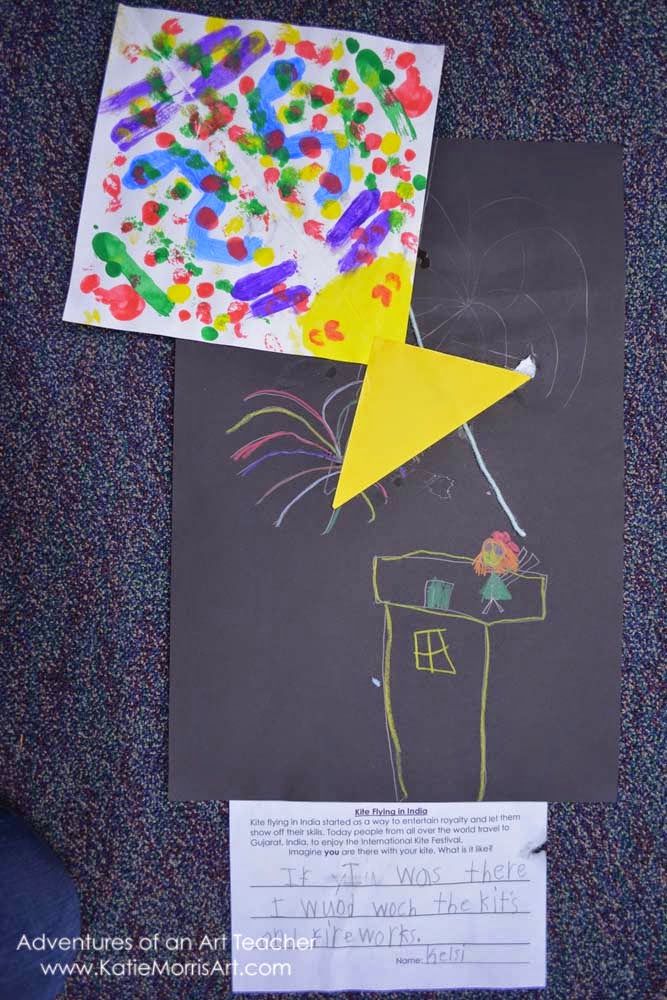
My 1st graders learned about the history of kite flying in India for their Cultural Heritage project. We watched the first part of a video about a Kite Festival in India that shows the transition from day to night.
We talked about what we saw in the video and then looked at some photos of kites. The students made symmetrical kites with liquid tempera. First, they folded the 9 inch (I think) square paper with a taco fold so that it would be oriented on the diagonal. Next, I showed the students how to paint a little section on one half of their kites, fold, and press, then repeat until they were satisfied with their designs. Originally, I was going to just have them make kites but then they wanted to add string, and then I started thinking about how to get them to imagine the experience more. 
In the next class, students created a drawing on either black or light blue 12x18 inch paper of the kite festival at either day or night. In the video, we saw many people on rooftops to fly kites so that is where most students drew themselves. After the drawing was complete, the students glued their kites and connected yarn from the kite to their drawn hands. 
 Nighttime was the most popular choice because there were lots of fireworks! A few students did choose daytime. I also very briefly talked about perspective and how the kites look closer to the viewer since they are bigger than the drawn people.
 Students wrote sentences about their imaginary experience at the kite festival. Click the picture for a larger view if you want to decipher cute beginning of the school year 1st grade sentences. :)

Sunday, November 9, 2014

Rangoli Drawings

This year the focus for Cultural Heritage Week in my district has been India. Each art student in the district, K-12, has made artwork inspired by the culture of India. My K-3rd grade students each had a set assignment and the 4th-6th grade students had multiple starting points from which to branch out and choose a direction. 
3rd grade students learned about rangoli, which are created during Diwali celebrations. You can find the lesson plan on the smARTteacher, but I'll go ahead and post the basics below.
Start with square construction paper. I cut down 9x12 inch paper to 9 inch squares. I went ahead and chopped the scraps into 1 inch strips that will be used for paper weaving.
Trace a circle in the center of the paper. We used big cans from the lunch room. Place a dot in the center of the circle and 6 or 8 dots evenly spaced around the perimeter.
Next, students create radial designs. I describe it to them as making a pizza where each slice is the same. After the designs are planned in pencil, students add color with construction paper crayons or color sticks.  True rangoli are usually created by drawing with sprinkled powder or paste onto the ground. I wanted students to be able to get part of that experience so after they finished coloring, students had the option of tracing part of their designs with glue and sprinkling sand over the top.
 Only one or two students decided not to add sand. Sand is always a big hit!
We loved how this project turned out. India is such a colorful culture and the students have been so excited to learn about it.