This was a popular lesson with my 7th graders. They learned about Andy Warhol's Endangered Species prints and researched the Endangered Species Act before choosing a species that is currently threatened or endangered to focus their artwork.
I uploaded the lesson plan and all the resources on the smARTteacher!
We used polyfoam plates and students engraved their designs with a wood stylus. They tried out printing with markers and with relief ink.
To print with markers, color directly on the foam plate, wet your drawing paper with a damp sponge, then place the paper damp side down on top of the plate and rub the back to transfer the image.
Next, the students used relief ink. They could do one color or multiple. The students got really in to printmaking! Some that finished their first prints early and became the class experts, helping others. They wanted to do printmaking the rest of the year!
The last part of the assignment was to create a display that had a photo of and facts about their animal, an artist statement, and their best print.
If you're like me, you stop and look at EVERY picture in the collection when you see something like "Dad turns his 6-year old son's drawings into reality" pop up in your news feed. I started thinking that it could turn into an interesting assignment for my computer graphics class!
I started by asking the students to draw an animal from memory- NO LOOKING at a photograph. Next, I explained to the students that I wanted them to use Photoshop to make a picture of the real animal look like their drawing.
Some needed to combine multiple parts of different photos to match their drawing and some were able to make changes with the liquify tool, clone stamp, or selecting and rearranging parts.
Here is my example including the (not very accurate) first drawing!
Some kept the background simple, some needed to replace it with a new photo to complete the scene.
I think this lesson will be a keeper for next year. It was fun for the students to do, they had to make appropriate choices from their arsenal of tools, and it only took a few class periods to complete.
Last summer I saw an idea on Twitter to make portraits of pets up for adoption, auction them off to raise money for the shelter, and HOPEFULLY raise some awareness and help the pets get adopted. I thought it was an awesome idea so I proposed it to my art club.
The original plan was to display the artwork inspired by the pet's photos in a coffee shop in town for a few weeks before having a silent auction. Well....... my art club is not the best at following through so by the time I had more than two finished, we just posted the pictures on our facebook page and had a silent auction that way. I matted or mounted the artwork and had the winner (the same person bought ALL 4 of the pieces) write her check directly to the Humane Society. They were appreciative of our efforts and I hope that we can do this again even more successfully in the future.
My students are always interested in drawing animals. I had that in mind when I stocked my "inspiration station". In addition to the animal encyclopedia set I was given when they were discarded from the library, I picked up several plastic animals at the Dollar Tree to be used as models.
I also added some penguins that were mine when I was little. Unfortunately the penguins were stolen! I was very disappointed and said that I would be happy if they just showed up outside my door one day, but nobody returned them. One little guy still asks me almost every week if I ever found them!
Giant rabbit or a tiny carrot. I'm not sure. I am sure that I was very excited with the composition! It can be such a struggle to get students to fill the space of their paper.
A Kindergarten zebra and a 3rd grade dinosaur.
Colorful fish.
The lizards have been very popular, though I have to keep remind some students to observe them, not try to trace them.
This drawing came a long way from the time this first grade student first told me she was finished. I encouraged her to add more value in the grass and to make the ladybugs more solid. She also went back and blended in other greens to make it more interesting. I always with that I would have remembered to take a before picture to show the students how far they've come!
This 3rd grader worked on his bug drawing for several weeks, adding more variety each class. Here's the artist statement: Bugs are cool they have all kinds of cool life skills. They have different defense methods too.
I decided to look for a connection to 6th grade curriculum when planning their clay project. 6th grade studies ancient Egypt in Social Studies and I wanted to try to find some new inspiration- something I hadn't seen before. I came across this beautiful little guy below on the Metropolitan Museum of Art's website and fell in love!
"This well-formed statuette of a hippopotamus (popularly called "William") demonstrates the Egyptian artist's appreciation for the natural world. It was molded in faience, a ceramic material made of ground quartz. Beneath the blue-green glaze, the body was painted with the outlines of river plants, symbolizing the marshes in which the animal lived." (http://www.metmuseum.org/collections/search-the-collections/100000444?img=2)
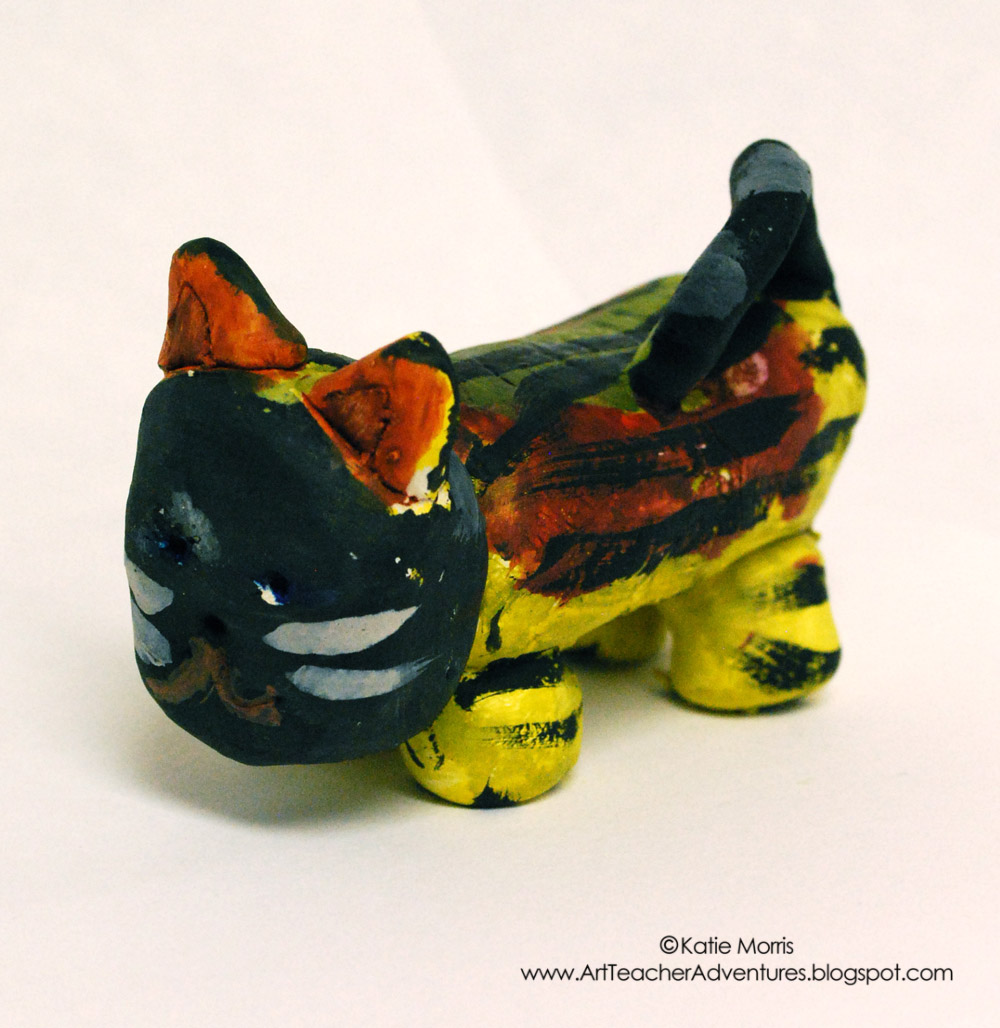
It was so easy to make a connection to the Hippopotamus statue without cloning it. The students used clay handbuilding techniques to sculpt a favorite animal in the first class. In the second class period, they painted their sculptures with tempera cakes then either used a small brush to paint organic forms from the animal's natural habitat or an unwound paper clip to scratch the designs into the surface.
Each student was given a handful of clay (my measurements are sooo precise) with which to sculpt. Some used all of it while others went from "small scale" to "miniature" with teeny tiny sculptures. Animals are always popular and the students really seemed to enjoy the project. I have a big stack of discarded library books with animal pictures that the students could reference if they wanted and they could choose any animal as inspiration. The animals could also be painted any color- hippos are not blue in real life and that was ok with the Egyptians so it's ok with us!
Several students chose to make snakes, because they were "easy". We did talk about how a snake sculpture like the one on the left is much more interesting than the one on the right. If I saw they were making a snake, I tried to show examples of how to give their snakes a more dynamic pose.
We used toothpicks or small pieces of reed for things like antennae that would break if made of clay.
Some students spent all their time painting and didn't get to the plant shapes. It was a little tricky to figure out if they used a domesticated animal.
Here is a close up to show how this student scratched the designs into wet clay then defined with paint.
This panda is holding the bamboo instead of having it scratched into the body. Not a huge deal.
I LOVE this chameleon!
In case you ever wondered what is in a unicorn's natural habitat, the answer is flowers and rainbows.
Teeny tiny pig.
I just told the 6th graders making turtles that they better be more advanced than my 1st grade turtles!
Snake on a rock.
Somehow this student got his dinosaur to balance! We leaned his head against the wall of the shelf for support while it dried.
Have you ever seen an elephant paint? I haven't in person, but I have seen several videos on the internet. Most are abstract paintings but some elephants have even been trained to paint a "self portrait" that really does look like an elephant. I thought that watching some elephants paint could lead to an interesting discussion. I showed my 3rd graders some pictures and videos of animals painting (see my board on Pinterest) then we spent some time talking.
What is an artist?
Who can be an artist?
Can animals be artists?
Why or why not?
Most of the students right away will say that yes, animals are artists. I wanted them to think more deeply- sure, lots of animals can paint. But does painting something automatically make it Art? To explain my thought, I usually ask them something like:
What is the difference or is there a difference between painting a wall in my house a solid color and making a painting?
I want them to understand that it is not the mere action of painting, but the thought behind it. Then they are not all in agreement anymore about animals being artists and I'm happy because they are thinking and forming their own conclusions. :)
My conclusion- elephants are pretty intelligent so I think it is possible that their paintings could be Art if they are making the choices not strictly performing a task in which they have been trained. Continuing...
I also like to ask why zoos would want animals to paint- so the animals don't get bored, so they can raise money, etc.
Next, the students get to paint like elephants!
I made stations by setting up two big boxes I knew I would use sometime on the tile section of my floor. The students taped their paper to one side of the box so 8 were able to paint at a time. The students who were not painting during each shift were working on "free" drawings. The painters dipped their elephant trunk brushes into paint trays set on the floor and had about 2 minutes to paint. You probably don't want to give the students much longer than 2 minutes or you'll get mud. I did not make water available for brush cleaning so I just showed them how to dip, not stir to get a new color. When a student finished, s/he removed the painting, washed the paintbrush, and put it by the paint to signal that another student could take their spot.
How to make an Elephant Trunk paintbrush
1. Get a long ruler.
2. Tape a long paintbrush to the long ruler.
3. Hold paintbrush by the end of the handle and use your extended arm to paint.
I had the students put their wet paintings on some shelves to dry for a few minutes before we did the last step- handprint elephants. I had one student at a time come up to print their hand by just pulling the next painting in line. I used a brayer to roll gray paint on the palm of each students' hand and they chose how to print it. The paint was still wet underneath the handprints but not so wet that it smeared. We had to rush, but managed to get every handprint done in time. (All except for the class that had a fire drill right in the middle.) I know some people are dead set against handprint Art, but I think if you have a good reason, go for it. I knew that by adding an elephant on top of the nonobjective paintings, the artwork would look more finished and the students would remember the elephant/artist discussion. I knew that by using a handprint for the base the students would be less frustrated and parents would be more likely to keep them.
In the next class period, the students turned their gray handprints into elephants by adding outlines and details with sharpie then highlights with some watered down white tempera.
I've been playing with my Animoto account and made a little video that I'll send to parents in an Artsonia newsletter. If you check it out, you'll see a few seconds of the students painting like elephants on the butcher paper that became our bulletin board!