Showing posts with label growth. Show all posts

Monday, March 19, 2018

Evidence of Growth: Observational Hand Drawings

For one of my growth measures this year, I decided to focus on observational drawing skills with my 8th graders. First, I asked the students to draw their hand without any other instruction. This served as the pre-assessment. The next couple of class periods were spent on drawing skill builders like continuous line drawings, blind contour drawings, and even drawing with the non-dominant hand to try to get students to slow down and look closely.

After the practice and a few pep talks given to my class about how art is a skill that CAN be learned, I demonstrated drawing my own hand from observation, sharing some tips on measuring and comparing proportions, and later demonstrated shading, before the students started the post-assessment of drawing their hand from observation applying what they'd learned.

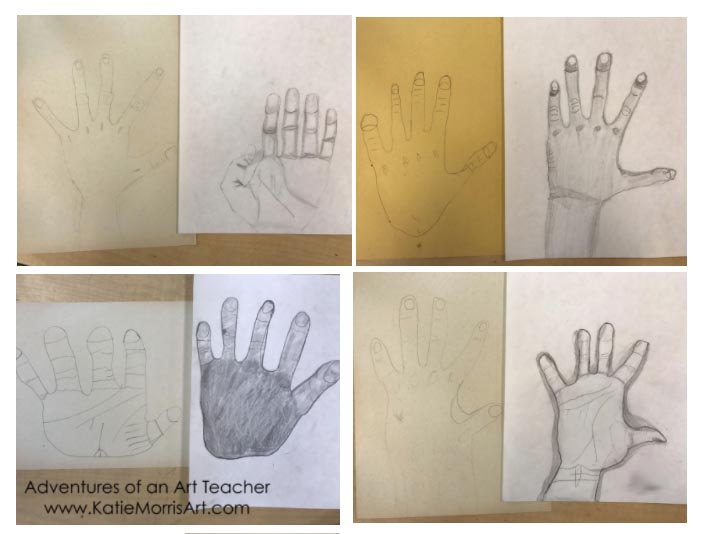
I used a simple rubric to score the pre and post assessment drawings so that I could give numerical evidence of growth. It's so easy for us to see improvement but administrators tend to like numbers. The document I turned in had a section about why observational drawing is important, and explained the process from pre-assessment, instruction, post-assessment, and then the evidence. I included a graph and a chart with scores before and after as well as percentage of growth. Even though numbers proved the growth, I still included some side by side photographs at the bottom of the document, which my principal said he appreciates seeing.

Here is a copy of the document I turned in, except with student names covered and replaced.

Importance: Observational drawing is a foundational skill for many art media and processes and the benefits from the studio habit of “observation” carry over into many non-art activities and vocations. Hands are one of the parts of the figure that students tend to avoid or struggle to draw so instruction in it now will help students feel more comfortable with the task in their future work.

Pre-Assessment: The students were asked to observe and draw their own hand without any prior instruction. The work was assessed with the following rubric.

Below Standard- 1 Approaching Standard- 2 Meets Standard- 3 Exceeds Standard- 4
Student:
Pre-Assessment
Post-Assessment
Scale: The proportions are correct- the sizes of parts of the hand are correct when compared to other parts.


Observation: The hand is drawn accurately and attention was paid to details.


Craftsmanship: It is evident the student put care into the work to make it as good as it can be.


Growth:


Teaching: After the pre-assessment, the students practiced drawing hands with a continuous line drawing, a blind contour drawing, and drawing with their non-dominant hand, all activities which are supposed to help the artist slow down and look carefully. Next, the teacher demonstrated drawing her hand, shared tips for dealing with parts of the hand, and talked about proportions and measurement tools.

Post-Assessment: The students were asked to again observe and draw their own hand applying what was demonstrated. The work was assessed with the same rubric.
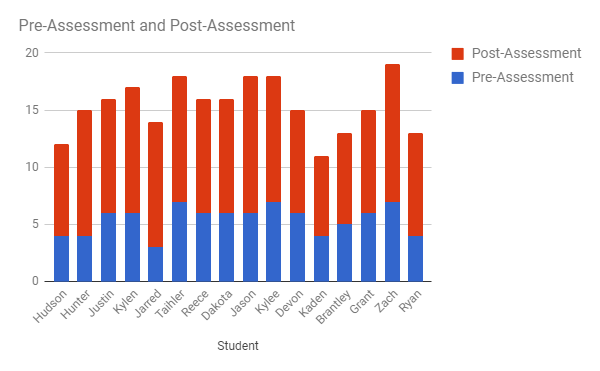

Student
Pre-Assessment
Post-Assessment
Growth
Growth %
a
4
8
4
200.00%
b
4
11
7
275.00%
c
6
10
4
166.67%
d
6
11
5
183.33%
e
3
11
8
366.67%
f
7
11
4
157.14%
g
6
10
4
166.67%
h
6
10
4
166.67%
i
6
12
6
200.00%
j
7
11
4
157.14%
k
6
9
3
150.00%
l
4
7
3
175.00%
m
5
8
3
160.00%
n
6
9
3
150.00%
o
7
12
5
171.43%
p
4
9
5
225.00%

Photos of Pre and Post-Assessment Comparisons
(Pre-Assessment Drawings are on the Left)


Saturday, September 30, 2017

Showing Growth- 8th Grade Observational Hand Drawings

For one of my growth measures this year I decided to focus on observational drawing with 8th graders. Observation is obviously an important skill in the art room and across the curriculum, and drawing from life is a skill that most students could improve upon.
I started by asking the students to draw one of their hands without any other instruction from me. I let them work as long as they wanted and for most that was maybe 15-20 minutes. I collected the "pre" drawings and then we moved on to some drawing exercises like continuous line drawing, blind contour drawing, and drawing with the non-dominant hand, that are supposed to help students practice slowing down, looking carefully, and translating what they see into what they draw.

Oooooh the whining! This particular group of students spends a lot of time saying "I can't do it" and "I'm not an artist". My response is always that "I'm not a mathematician but I can still do math!" It was pretty frustrating to battle that fixed mindset so at the beginning of the next class period we had a pep talk before any artwork was pulled out. About 2/3 of my class (16 boys and 3 girls total) is on the football team and that is one of the biggest priorities in their lives. I drew a lot of comparisons between art class and football practice and told them that art CAN BE LEARNED, it's not something you're just good at or not. I said that I'm not great at throwing a spiral, but if I practiced I could get better. Probably not as good as the starting quarterback, but I could improve MY skills and show growth. I reminded them that my goal for them is to approach art like they approach football- listen to the coach, take the advice, practice, and improve. After that their attitudes were significantly better!
I demonstrated drawing my hand, and shared some of my little "tricks" (that aren't really tricks) for drawing knuckles, creases, etc. and measuring proportions.  The students had a few days to draw their hand and apply what they'd learned. Since some got their contours drawn faster than others, we also reviewed graphite rendering. I was really pleased with their progress and I think the students were surprised to see the comparison from pre and post!
I really hate rubrics but since evaluators usually want quantitative data over qualitative, I scored the following categories with this scale:
"Below Standard- 1    Approaching Standard- 2    Meets Standard- 3    Exceeds Standard- 4".

Scale: The proportions are correct- the sizes of parts of the hand are correct when compared to other parts.

Observation: The hand is drawn accurately and attention was paid to details.

Craftsmanship: It is evident the student put care into the work to make it as good as it can be.

The document I will submit has an explanation of who and why, a copy of the rubric, a chart showing scores and percentage of growth, and because I'm visual, a graph and comparison photos.

Monday, August 7, 2017

"Art 1" Pre-Test

I've seen several posts lately with people asking what kind of assessment they should be using in an Art 1 type of class. Last year I decided to give a pre-test the first week of school with information that would be covered in all of the 1st semester boot camps. I used my planning notes to come up with the questions and gave the same test to students for their final in December. Since I was able to use an extension to have the internet grade for me (now Google Forms has a quiz setting so it's even easier) it was super easy to compare pre and post test scores which became a piece of evidence for my evaluation.

I'm planning to tweak the questions for my new school year plans and give it again.

When painting it is best to start with
What is it called when you add white to a paint color?
What is it called when you add black paint to another color?
What do you get when you mix two complementary colors?
Complementary colors are...
How do you make a color lighter when using watercolors?
How do you make a color lighter when using acrylic?
To get a paintbrush clean at the end of a session you should...
Paintbrushes should be stored
How do you create a secondary color?
How do you create a primary color?
Which is a complementary color pair?
In art, what does "value" mean?
When it comes to graphite drawing pencils, which of the following is the softest?
When it comes to graphite drawing pencils, which of the following is the hardest?
An eraser is...
How do you protect a drawing made with chalk, pastels, or charcoal?
Oil pastel works are supposed to look like...
What is the best way to make colored pencils look more solid or brighter?
What are the very best ways to get images to use in your artwork?
Finding a cool painting online and making your own copy is...
The point in a picture where the sky meets the ground is called...
In a perspective drawing all receding lines connect to the
Clay comes from...
To attach clay pieces you should...
What is important to ensure all the pieces of a slab-built vessel fit together?
Which hand-building method starts with a ball of clay?
What is the correct order of the progression of clay from wet to finished?
What is the correct order of the steps for throwing a bowl on the potter's wheel?
What are you hoping to get out of this class?
Your answer
SUBMIT