Showing posts with label writing. Show all posts

Friday, March 6, 2015

Everything is Awesome- Lego YAM Bulletin Board

 The Youth Art Month bulletin board at my primary school is Lego themed. Ever since I watched the Lego Movie, I've been wanting to use the "Everything is Awesome" theme for art. This was a good chance!
I downloaded a free Lego font to print off the phrase. Big time saver.
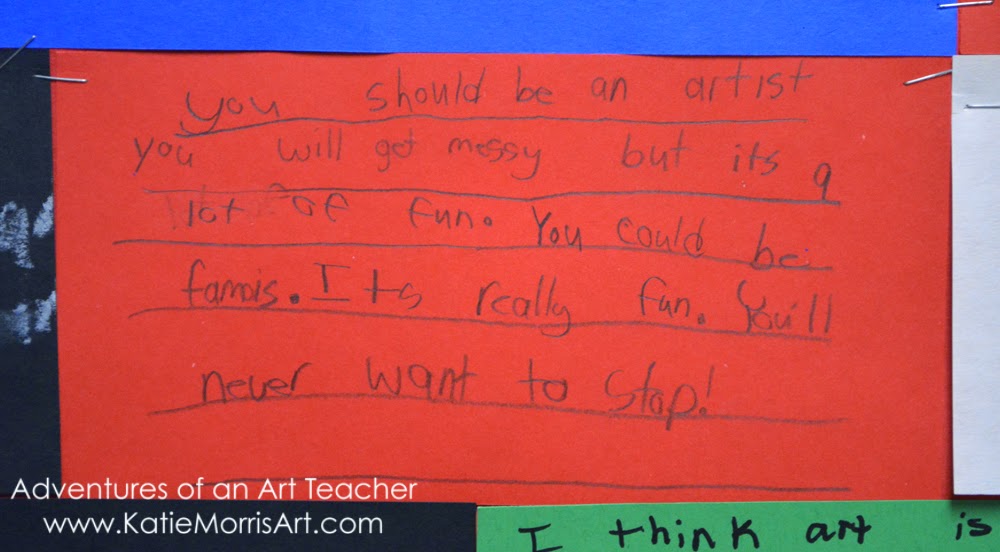
To create the Lego mini figures, I posed an actual figure, photographed it in three positions, projected it onto big construction paper, and traced. My student teacher and I added color with color sticks and cut them out. I made a Lego brick template to trace for the top row and cut rectangles in different lengths to create the rest of the wall. I let early finishers choose a brick on which to write why they like art or why it's important before I stapled them onto the bulletin board.

Here are a few of the students' bricks.
"I care about art because it is fun and you get to paint. It is real fun. Everyone has good art. No one draws bad and draws good. It really means a lot to me and everyone come in peace. It is a lot of fun. It is full of fun."

Tuesday, June 10, 2014

Kindergarten Puppets

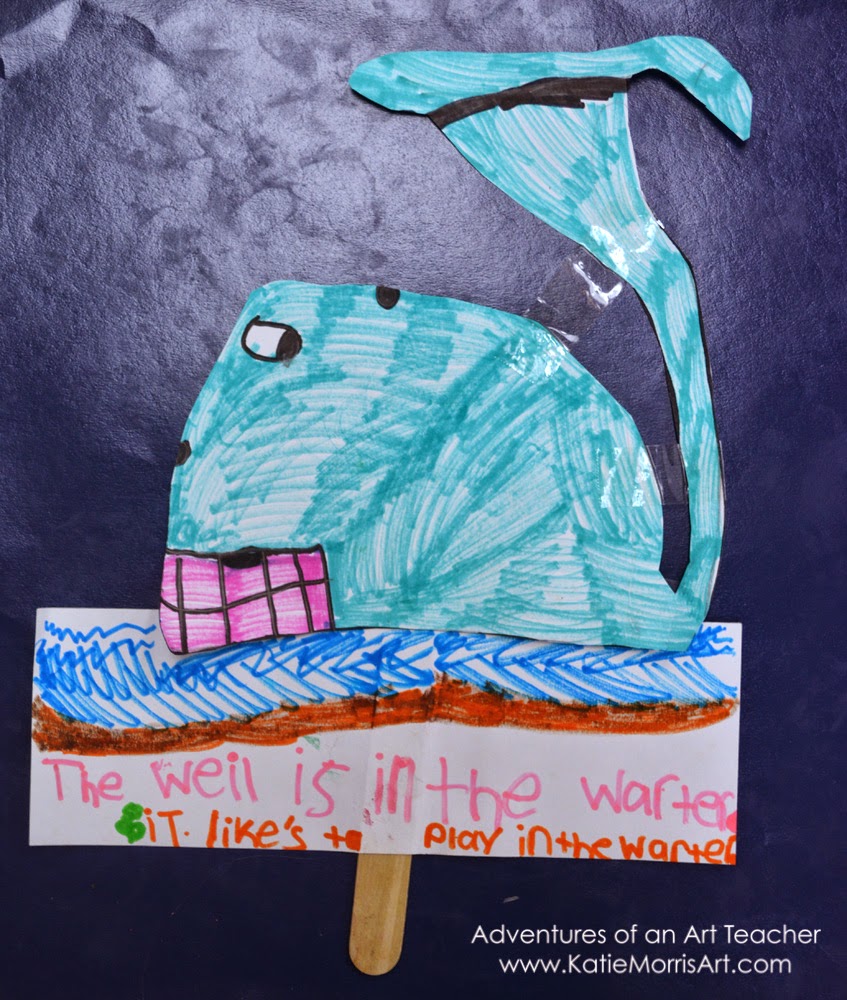
At the end of the school year, I introduced puppet making to my Kindergarteners. The results were pretty funny, and lots of plans for making plays together were overheard.


The students simply made drawings on drawing paper, traced with sharpie, colored, cut out their drawings, and we taped a big popsicle stick to the back. Easy peasy!
This student added her narrative to the puppet stick. It's amazing how much writing improves in one school year!

Saturday, August 4, 2012

1st Grade Tornado Safety

 This is the 3rd year I've taught a variation of a tornado safety lesson. The first year it was pretty much just a collage. Last year I added more mixed media elements, and while it improved the visual, I still wasn't completely happy. This year I am much more satisfied. The difference this year, is that the students wrote their own safety tips. I was afraid to do this before because I wasn't sure if I would have time to read all of them, and I didn't want the students to write something that would actually be dangerous when we were learning about something that could be a real life and death situation. I emailed all the 1st grade teachers about having the students write tips in the classroom and bringing them to Art class ready to go. Fewer than half remembered to send them (I'll send a reminder on the day of Art class next year) but the classes who forgot were able to write them in Art class without too much trouble.
 Day 1: *Tornado safety info, geometric shape review, give students primary colored tempera paint to paint squares or rectangles for base of house at bottom of paper, students cut triangles from newspaper to form the roof for their houses, glue newspaper to background. (Start with squares of newspaper and show the students how to cut diagonally corner to corner or cut off a corner with one straight line to form their triangle. This saves lots of time and frustration if they actually listen.)
John Steuart Curry, Tornado Over Kansas, 1929, Muskegon Museum of Art
*Edit: I forgot to say that we also discussed John Steuart Curry's painting Tornado Over Kansas. We pointed out how the family is taking cover to stay safe.
Day 2: Students use crayon to color background/sky while supplies are being passed out, demonstrate tearing 1/2 sheet of black construction paper into an organic tornado shape, glue tornado onto paper, use color stick or opaque colored pencil to write safety tips directly onto black paper tornado, add more details with crayon. (The students may be frustrated by not using scissors, but push through! It's good for developing fine motor skills and makes the edges of the tornado soft which is good since they are not solid things.)
This project could be adapted to help review and prepare students for any natural disaster or safety situation. I like to do this in the spring around tornado season when we start having hallway drills at school.
 I decided to make a hallway display with the tornados this year since they were finished a little earlier- last year they were just finished in time to go home before the end of the year. When students finished early, I asked them to think of a word that they associate with tornadoes. They wrote the word on a big torn paper tornado I made out of butcher paper and labeled with "Tornadoes Are..."

Here's the hallway display. I used the big tornado and picked 10 pieces of student work that had different (accurate) tips on them. I cut out my letters and used a 1 inch round punch for the negative space in the letters. I thought it was kind of fun. Then I used the resulting 1 inch circles to make a dotted line under the word "Safety".
Wednesday, July 25, 2012

Sand Surrealism and Artist Statements

I wrote about my Surrealistic Sand lesson that I teach to 3rd grade last summer but I just had to share some results from this year. This project can be a challenge for students but it is such a different way of working than they are used to that I love teaching it. The students learn about Surrealism and Masson's Battle of Fishes then use the automatic process of drizzling glue and sprinkling sand on it as the stimulus for their idea.
This student remembered Dali's Swans Reflecting Elephants from my Surrealism PowerPoint and was so excited to show me that his project is a stingray from one direction and an elephant from the other.
Cygnes Refletant Des Elephants - Salvador Dali
Swans Reflecting Elephants via WikiPaintings
Here are a few others:


This year my SMART goal was focused on improving 3rd graders' ability to express ideas in Artist Statements. When my students write Artist Statements, I ask them to answer "What, How, Why, How"- What did you make? How did you make it? Why did you make it (what were we learning about)? and, How do you think it turned out? While I didn't meet my goal, I did see big improvements from the "pre-test" Artist Statements at the beginning of the year that were mostly something like "This is a fish. It's pretty."

I thought it was funny that this student made her project because "number one I did not want to get in trouble"

Monday, December 19, 2011

Organic Shape Monsters


The inspiration for this lesson came from Joanna Davis at We Heart Art- Organic Shape Monsters. I love (LOVE!) her idea of using yarn tied in a not to teach organic shape.


I pinned the idea for the yarn, intending to do something different with it, but my 1st graders and I were kind of on a monster/wild thing kick so it stuck in my head! I do try not to look at many photos when I'm planning that way it's easier to kind of put my own spin on it. Not that there is anything wrong with not spinning, or that I really spun this one all that much.  Each student got a piece of yarn that I had already tied in a knot and moved it on their paper until they got an organic shape that they liked. They traced with pencil then added details. I told them that their monsters had to have a mouth and at least one eye, some sort of pattern, and a way to get around (does it walk, fly, swim?) After planning in pencil, the students used markers to add details. I always have to remind the students to use the right size tool for the job. I put out regular size markers for coloring in big areas and skinny markers just for tracing lines and adding little details. Of course you'll always have a few students trying to color in their whole monsters body with a teeny tiny marker. I like to just hand those students a marker of the right size and walk away.

The first class was for drawing and starting to add color. I didn't want to keep these as plain drawing since the students had already made Wild Thing drawings and I was trying to decide what exactly to do when I saw a photo my Art Teacher friend, Miss Ihrig, posted on Facebook of her students monsters cut out and glued onto bright colored construction paper- perfect! It was also good since I hadn't cut or glued much with 1st grade yet this year. I took the opportunity to talk to the students about contrast before I let them choose their construction paper. I have a bunch of little girls who LOOOVE pink and would make everything with pink markers and pink crayons on pink paper if I let them. The problem is that monochromatic artwork when everything is the same color is a little hard to see. (They can't quite pull off the subtlety of Rothko's black on black paintings...) I encouraged them to try holding their monster up to different colored backgrounds to see what looked best. Most just pretended to consider other colors then picked their favorite anyway. :)


After carefully cutting and gluing, I asked the students to write a story about their monster. If they needed more prompting, I asked them to tell me their monster's name and something they like to do. I printed off a half sheet writing paper template so they would have the lines they are used to writing on. When the writing was finished, I taped it from the back so their story is visible below their artwork. Students who were super speedy added details to their background with construction paper crayons. Or markers if I didn't notice in time! I think the story was the most interesting part of some. I have some leftover writing paper that I held onto for future lessons because it made their writing so much easier to read.

Wednesday, December 14, 2011

I am Wild When I...

Before the movie Where the Wild Things Are came out a couple years ago, there was a really awesome blog for it (We Love You So). They posted things about the movie, Maurice Sendak's book, and just cool artwork. One thing I remember seeing, though there is too much information for me to locate the exact link now, was a kids' activity where they were asked to finish the sentence "I am wild when I ______." I wanted to do some WTWTA art projects back in October and didn't want to stick with just drawing wild things (though we did that too, in 1st grade). I printed off sheets with the beginning of the sentence and space for the students to dictate their writing to me. I read the book to them and we talked about the story, especially the parts where Max was acting wild. I asked them to think of when they are wild like having fun, not wild like going to hurt someone. The students drew an illustration for their sentence and I wrote it for them in sharpie. If I were doing this with older kids, I would have asked them to write their own sentence. Since some of the Kinders are still learning to recognize letters, I figured there was nothing wrong with me printing it for them. This project was easily done in one class period. I loved the different answers the students came up with. Some tried to tell me exactly the same thing as a student they were sitting by but it didn't take too much prompting for them to think of something else to say.


"I am a triangle"- what a silly little boy, he is a Pre-K student that comes to Art with a Kindergarten class.


This little guy was definitely inspired by the book!

Saturday, December 10, 2011

Visual Poetry inspired by Austin Kleon

I first learned about Austin Kleon when his "Steal Like An Artist" essay was being posted all over the place last spring. (By the way, the book version is coming out in the spring.) I explored the website of the "writer who draws" and saw his newspaper blackouts, like the one below, Overheard on the Titanic, which are super cool!
Source: 20x200.com via Katie on Pinterest

Kleon makes poetry by starting with a newspaper and blacking out the words he doesn't need to make a new meaning.

I decided it would be fun to try the technique with my 6th grade students. Because I wanted to make it a one class period project, I chose about 20 newspaper articles/horoscopes/editorials with interesting words and photocopied them. Part of me wanted to just give the students a newspaper but I knew I would end up with students who had not chosen an article to work on by the end of class. I suggested that the students scan the article for words that jumped out at them and underline those words with pencil. That way they could see their choices and construct their phrase or sentence while still being able to fix mistakes. Next, they were supposed to draw a box around the words with sharpie and black out the words they didn't need anymore. By drawing the box first, the students were less likely to get in a hurry and black out an important word. Quite a few are pretty hard to read because they still got too close to the words. If you do this with your students, make sure to remind them to leave as much space around the word as they can. I didn't say that had to, but most of the students checked with me before starting with sharpie. I was able to give some advice, like to make it shorter, or construct a new meaning because some were basically summarizing the article. Another thing the students have to think about is how to direct the viewer/reader's eye. If the article has columns based on how they use the sharpie, the students can make you read left to right or down each column.
 Before I presented the lesson to the next group of students, I found one of Kleon's newer blackouts that makes a subtle picture with the negative space. I encouraged the students to think more about the negative space and the overall design. I'll admit that a few students were a little confused as to why we were doing this in Art class. I told them that it was part poetry and part visual art because of how they created the design with sharpie.


You all know how I love bulletin boards. I was ready to switch out my design and thought this would be a good opportunity to explain what the artwork was all about. Plus, I was excited to use the old joke. I covered the background in newspaper first. I don't have many borders so I put out an email to see if I could borrow a red border from anyone. I got some offers but the reds were all more red-orange, not what I had pictures. So, I decided to just dry brush a red tempera paint border on. Then I used some of the leftover red paint to make a frame around the explanation. I had die-cut letters for "What's black and white and 'read' all over?" and glued them to black construction paper so I can reuse the title some day and not have to worry about keeping all the letters together. I filled in the extra space with some student work. Also, I was relieved to find out that most of the students still know this joke! Or at least some silly version of it.