|
| I love to see variety in the hallway! |
This lesson has a fairly simple idea, but I am so proud of the result. Since I've been thinking and reading about different theories/philosophies in Art Ed this semester, I think this is more of a TAB-ish approach than what I usually do. I struggle with finding what I feel is an appropriate balance between teacher and student-directed learning and I like the way this lesson was balanced.

This lesson takes 2-3 40-minute class periods. In the first class, I gave the students a description worksheet. Before class, I hung prints and posters all over my classroom. More than usual. I tried to select prints with a lot of variety in technique, time period, subject matter, etc. I made small, brightly colored number labels for each to make identification easier. Each 4th grade student was to choose a print to observe, and use the worksheet to help them think about what they were seeing. I modeled observing a print that was not an option for them, making sure to use "Art words" in my description. After most students were done, I stopped and explained what the studio portion of the assignment would be: Use some elements of your description to design your own Art project. It should have some common elements but definitely not be a copy.
So, the inspiration could come from the content, style, or just about any element of the artwork. The students' idea either had to be described in words or in a sketch on the back of their worksheet. They waited in line to have a very quick conference with me so I could help them figure out which materials would help them best communicate their idea, and give them the right kind of paper. With the exception of a few students who "couldn't" think of anything, everybody got their assignment idea approved by the end of the first class.
The worksheet above goes with the artwork immediately below. The left half of the photo shows the inspiration piece, a mailer from a contemporary Art museum. The student said that the shapes at the top reminded her of a whale and the shapes below reminded her of picture frames. So she thought of a whale about to overtake a ship in a sort of tromp l'oeil picture frame. The only suggestion I made was that she add a shadow under the frame.
 |
| This painting was one of the artworks I chose to display in the Kansas YAM show at the Capitol. |
Some classes only had 2 periods to work, but most had, and needed 3. I gave choices of watercolor, tempera, colored pencil, marker, crayon, collage, or any combination (including the ever-popular wax-resist.) If the students had another idea that I did not mention, I just asked them to talk to me about it. I would have ok'd anything but clay since our supplies there are limited. I hope you enjoy looking at the results as much as I have. While they are not all as technically proficient as others, the idea was totally that of the student, and I loved seeing them take responsibility for their work!
Make your own
slideshow at Animoto.
Is anybody else loving that you can put Animoto videos on your school's Artsonia webpage now? I'm considering getting a real membership to make longer videos but I don't know if it'd be worth the money or not.
 |
| Inspiration: American Gothic |
 |
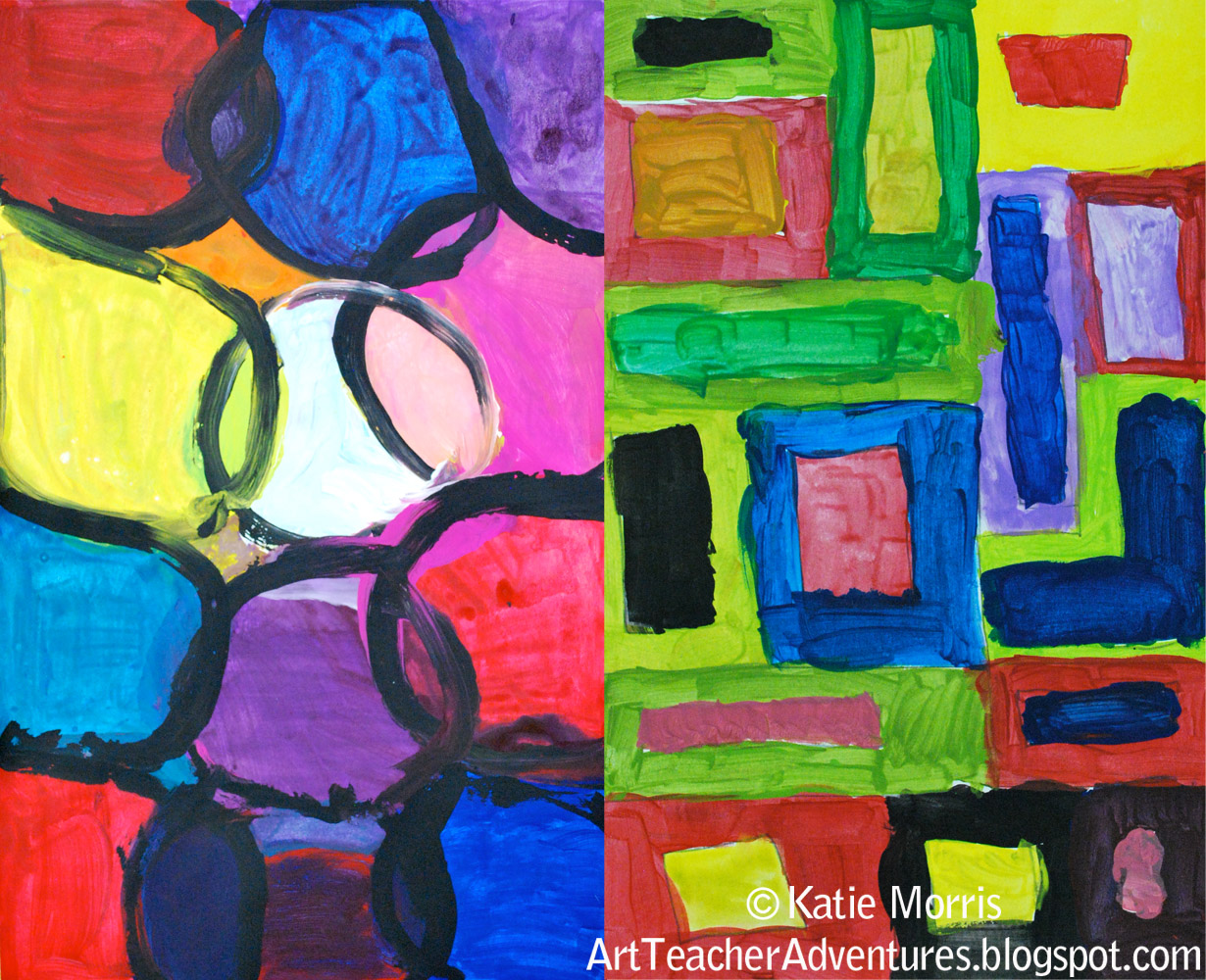
| Each of these students was inspired by bright colors and geometric shapes, interpreted in different ways. |
 |
| Inspiration: an Op Art painting featuring cubes |
 |
| Inspiration: Van Gogh's Cafe Terrace at Night |
 |
| Inspiration: Picasso's ink drawing of Don Quixote |
 |
| This student wants to be an architect. He's awesome at drawing in perspective even though I've never taught him how! |
 |
| Inspired by a painting based on a grid. She created a grid first then made her drawing on top. |
 |
| Inspiration: A folk art porcupine sculpture from somewhere in South America. |
 |
| Inspiration: Op Art painting of cubes. I helped make a template for the cube and she designed and constructed it. |
 |
| Inspiration: Sandy Skoglund's the Greenhouse. Student wanted to make the "opposite" which he said was cats instead of dogs, outside instead of inside, blue house and green cats instead of blue dogs and a green house. |
 |
| Inspiration: Escher tessellation of fish |


 This lesson takes 2-3 40-minute class periods. In the first class, I gave the students a description worksheet. Before class, I hung prints and posters all over my classroom. More than usual. I tried to select prints with a lot of variety in technique, time period, subject matter, etc. I made small, brightly colored number labels for each to make identification easier. Each 4th grade student was to choose a print to observe, and use the worksheet to help them think about what they were seeing. I modeled observing a print that was not an option for them, making sure to use "Art words" in my description. After most students were done, I stopped and explained what the studio portion of the assignment would be: Use some elements of your description to design your own Art project. It should have some common elements but definitely not be a copy.