Showing posts with label pumpkin. Show all posts

Sunday, May 21, 2017

TAB & Seasonal Artwork

One thing that people say they would miss in a TAB classroom is the traditional seasonal projects that students, staff, and families look forward to. I just wanted to share that festive artwork can still come out of choice-based classrooms! 
Last October (yes, I am suuuuuuper behind on blogging) I saw a bag of some cool little pumpkins in the produce section and bought them thinking that some students might be interested. I used the pumpkins for a demo in my 1st grade class, showing how I look at the individual sections instead of drawing a circle, and that observation helps me get the overall form drawn more correctly. I went ahead and reviewed some tempera techniques since students had been asking to paint and then I gave the students the option of taking a break from whatever they had been working on to draw or paint pumpkins or to continue with their own work. All but one student chose to paint a pumpkin. Their grade had recently been on a field trip to a pumpkin patch so there was a lot of excitement. 
I helped distribute requested paint colors and spread out the pumpkins for tables to share and then let students work. Some covered the whole surface of their papers with paint and some were satisfied after practicing the drawing. Some added scenery or turned their pumpkins into jack-o-lanterns and some left the pumpkins simple. The students used a traditional subject for fall art classes, but they chose how to engage with it and were absolutely delighted! I think the moral of the story here is that you don't have to "give up" special things that are important in your school community to TAB. It's about honoring the students as artists- giving them the choice and the voice to do it their way.

Bonus- if you like to incorporate other content areas, I found a great book at our local library that has estimation and counting in it- How Many Seeds in a Pumpkin by Margaret McNamara. If I had more time with the students we could have cut up the pumpkins when we were finished to see how many seeds they have.
I need to remember that there are nice display cases across from the 1st grade classrooms and take advantage of it! My classroom is at the high school so I don't always remember.

One of my friends started using TAB with her youngest students last year. She does a good job of putting out challenges in her centers and she has had some really successful themes! You can see more of what she's up to on her Facebook page or her blog, Ag Wife Artist Life 

Saturday, August 18, 2012

2nd Grade Value Pumpkins

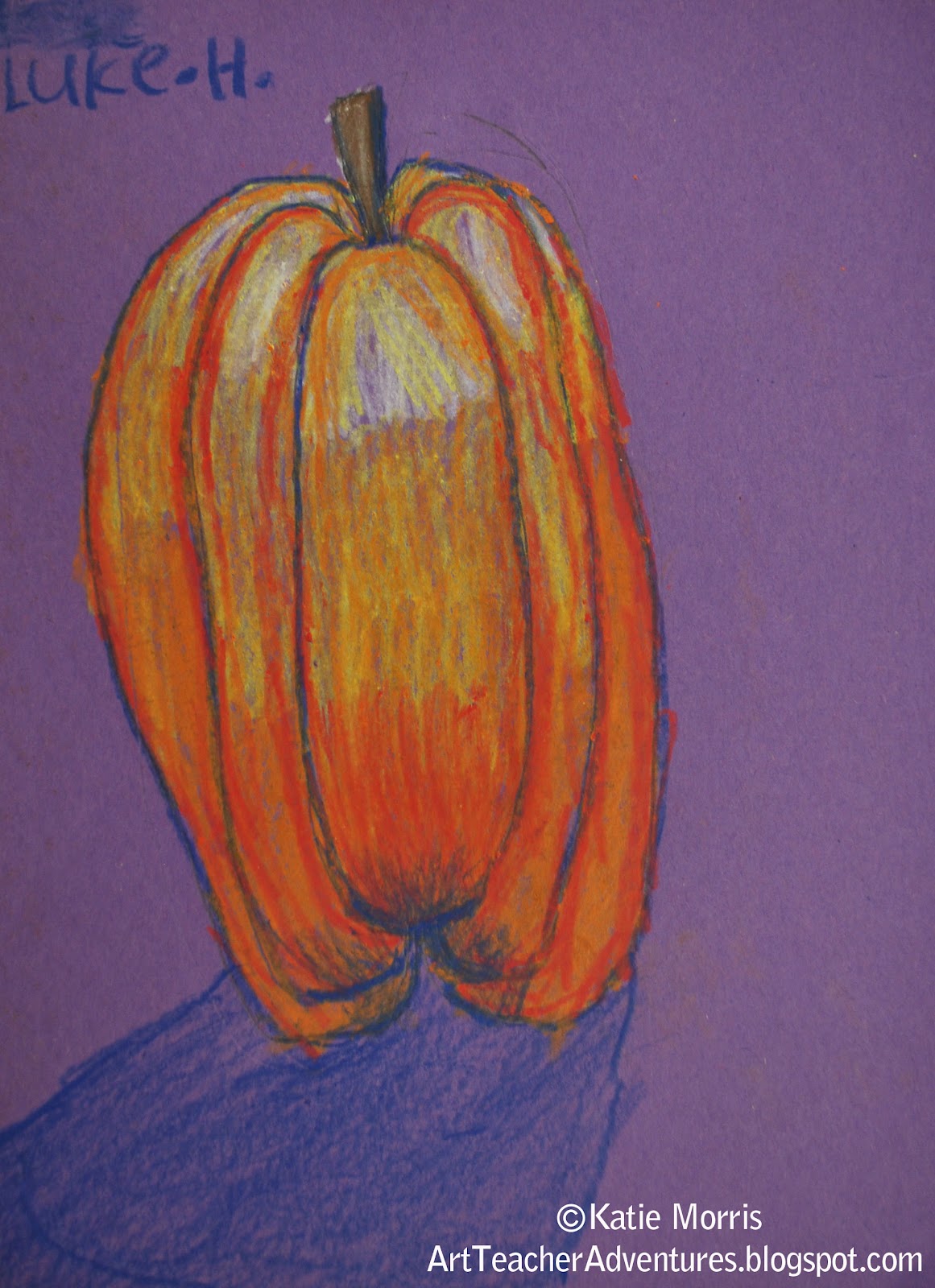
 Last year one of my goals was to really work on achieving a bigger value range with students, starting with 2nd grade. This 2nd grade lesson was definitely more skills-based than creativity-based. The students each drew a pumpkin then followed along as I showed how to use a variety of colors to achieve value.  It was great to see the students concentrating on adding more value on their own in subsequent art projects.
To add color, we worked light to dark starting with white crayon at the top of each section, and working downward, blending each successive color- white, yellow, yellow-orange, orange, pink-orange (there's no "red" in construction paper crayons for some reason.) It is important to color in each section separately and NOT across all at the same time. After the first layer, we went back and added more white at the top following the curve of each section, then blue at the bottom, following the curves up. Next, we added a shadow below the pumpkin. Students who had time were able to add any details they wanted to the background but for some reason I don't have many photos of pumpkins with backgrounds. You'll just have to use your imagination. :)
We used construction paper crayons on purple paper. I'm sure if we had used oil pastels, we would have been able to blend the colors more, but the few times I've used oil pastels with my students, EVERYTHING just ends up dirty. I'm not just talking about messy hands and tables, those I can handle. The oil pastels and the artwork just looks dirty when the little bits of other colors get mixed in. Still, I should probably give oil pastels another shot.

Saturday, August 11, 2012

1st Grade Pumpkins

 Last fall my 1st graders learned about line and color mixing in this pumpkin painting project. In the first class, we talked about lines. EVERY time I teach a lesson about lines to my primary students, I draw the different kinds of lines the students think of on the board, then we all "draw" them in the air with our fingers. The added movement tends to help the students remember better. Next, I led the students in drawing a pumpkin. 
Here's the trick that we like:
  1. Draw a large ellipse in the middle of your paper
  2. Add a "banana" shape on one side
  3. Add a "banana" to the other side so it looks like a hotdog in a bun
  4. Draw the stem above the middle ellipse
  5. Add another "banana" to each side

 Next, the students filled one shape at a time with a different kind of line in each and traced with crayon. We talked briefly about background then the students drew a horizontal line on each side of the pumpkin to represent the back edge of a table top. If the students still had time left, they added lines to the wall in the background and the table top.
In the second class period, I passed out trays with combinations of primary colors. First I gave each table red and yellow paint. They mixed orange and painted their pumpkin. While the students were painting with orange, I was preparing yellow and blue to be used for the stem and table. I prepped the red and blue paint while they painted green. It's a good idea to remove each tray of paint as the groups finish so they don't accidentally dip their brush into the wrong tray. Oh, and about the paint- I bought really cheap tempera, which I will never do again, but this project is the only time it not really being opaque worked in our favor. The students go to mix the liquid paint easily and still see the crayon through it.

I almost always give the students more choices than they had in this lesson. These are not the best example of creativity or artistic expression since they pretty much all look the same. But, it was good way to ensure that they really learned how to mix each secondary color and practiced at least 5 different kinds of lines. I'm telling myself that this is ok once in a while. Honestly, the students were super proud of their paintings even though they looked the same.