
I decided to look for a connection to 6th grade curriculum when planning their clay project. 6th grade studies ancient Egypt in Social Studies and I wanted to try to find some new inspiration- something I hadn't seen before. I came across this beautiful little guy below on the Metropolitan Museum of Art's website and fell in love! |
| PLEASE pin from the original source at the Met Museum instead of from my blog! http://www.metmuseum.org/collections/search-the-collections/100000444?img=2 |
"This well-formed statuette of a hippopotamus (popularly called "William") demonstrates the Egyptian artist's appreciation for the natural world. It was molded in faience, a ceramic material made of ground quartz. Beneath the blue-green glaze, the body was painted with the outlines of river plants, symbolizing the marshes in which the animal lived." (http://www.metmuseum.org/collections/search-the-collections/100000444?img=2)
It was so easy to make a connection to the Hippopotamus statue without cloning it. The students used clay handbuilding techniques to sculpt a favorite animal in the first class. In the second class period, they painted their sculptures with tempera cakes then either used a small brush to paint organic forms from the animal's natural habitat or an unwound paper clip to scratch the designs into the surface.
Each student was given a handful of clay (my measurements are sooo precise) with which to sculpt. Some used all of it while others went from "small scale" to "miniature" with teeny tiny sculptures. Animals are always popular and the students really seemed to enjoy the project. I have a big stack of discarded library books with animal pictures that the students could reference if they wanted and they could choose any animal as inspiration. The animals could also be painted any color- hippos are not blue in real life and that was ok with the Egyptians so it's ok with us!
Several students chose to make snakes, because they were "easy". We did talk about how a snake sculpture like the one on the left is much more interesting than the one on the right. If I saw they were making a snake, I tried to show examples of how to give their snakes a more dynamic pose.


We used toothpicks or small pieces of reed for things like antennae that would break if made of clay.

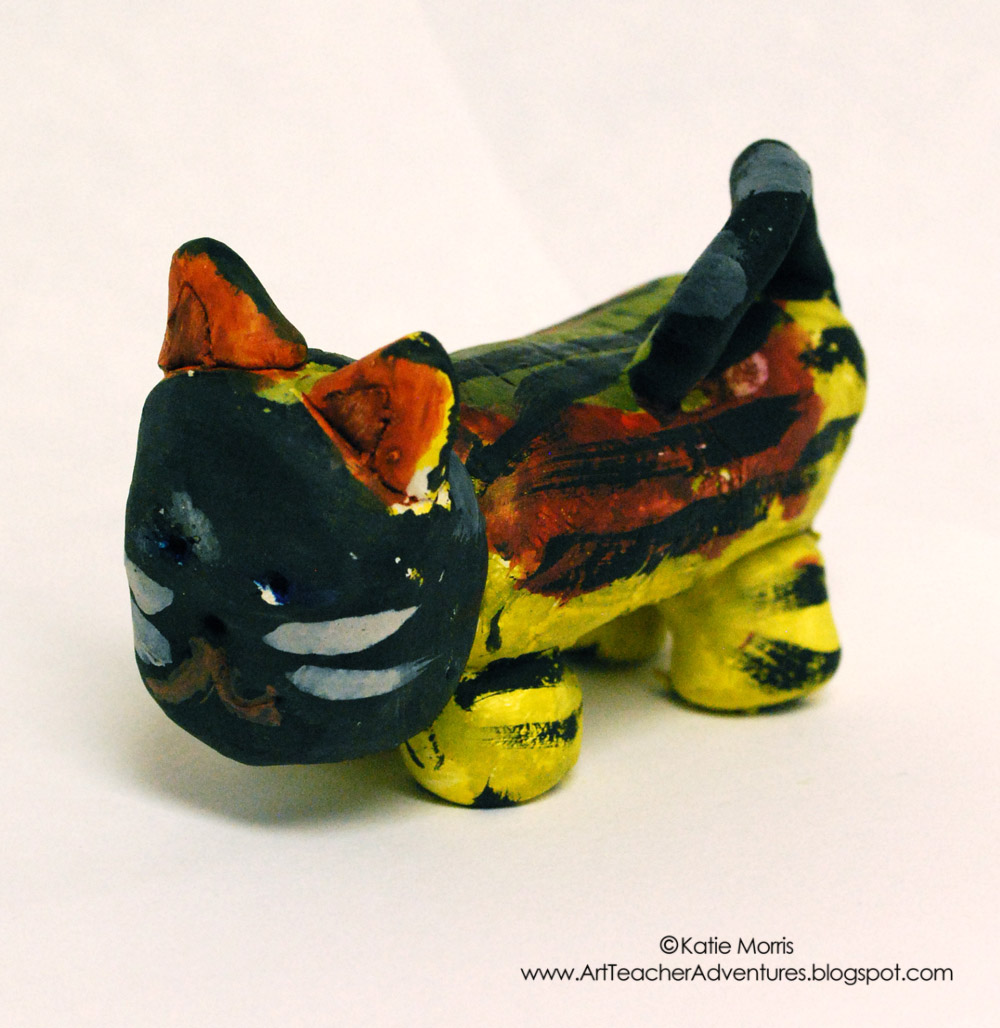
Some students spent all their time painting and didn't get to the plant shapes. It was a little tricky to figure out if they used a domesticated animal.

Here is a close up to show how this student scratched the designs into wet clay then defined with paint.

This panda is holding the bamboo instead of having it scratched into the body. Not a huge deal.

I LOVE this chameleon!

In case you ever wondered what is in a unicorn's natural habitat, the answer is flowers and rainbows.

Teeny tiny pig.

I just told the 6th graders making turtles that they better be more advanced than my 1st grade turtles!


Snake on a rock.

Somehow this student got his dinosaur to balance! We leaned his head against the wall of the shelf for support while it dried.


