Showing posts with label TAB-choice. Show all posts

Saturday, July 27, 2019

Artists Innovate

One of the Artist Behavior units we tried out in my advanced class 2nd semester was about artists using nontraditional materials or methods. I called it “Artists Innovate” because though less descriptive it was a lot shorter!

Here is part of the lesson plan:
  1. The students will view and discuss work by relevant artists.
  2. The students will apply paint or ink with non-traditional tools.
  3. The students will explore creating a traditional image with non-traditional materials.
  4. The students will explore creating sculpture with found objects and non-traditional materials.
  5. The students will plan and implement a project that is created with a non-traditional process or materials.

Procedure:
Day 1: Look at Chuck Close’s fingerprint portraits- layering prints to create different values- and discuss. Look at images of Matisse doing gestural drawing using a pole and discuss- why did he use that approach? Next, students will make a picture of a plant from observation either using their fingerprints or a paintbrush on a stick.
Day 2: Continue plant pictures, try the opposite of fingerprints or paintbrush on a stick.
Day 3: Look collage/fiber artists Mickalene Thomas, Bryan Grove, etc. Students make small traditional image with nontraditional media.
Day 4: Look at found object/assemblage artists. Explore available materials and play/experiment.
Day 5: Come up with a proposal and present to teacher. Work on project!
Days 6-20: Work on assignments.
Here are two examples of the traditional subject, nontraditional approach exercise. Plants made with a paintbrush on a stick and with fingerprints.
This student turned a broken hair dryer into a drawing machine. He melted crayons on the blades and figured out how to still make the fan run with a little help from our technology teacher.

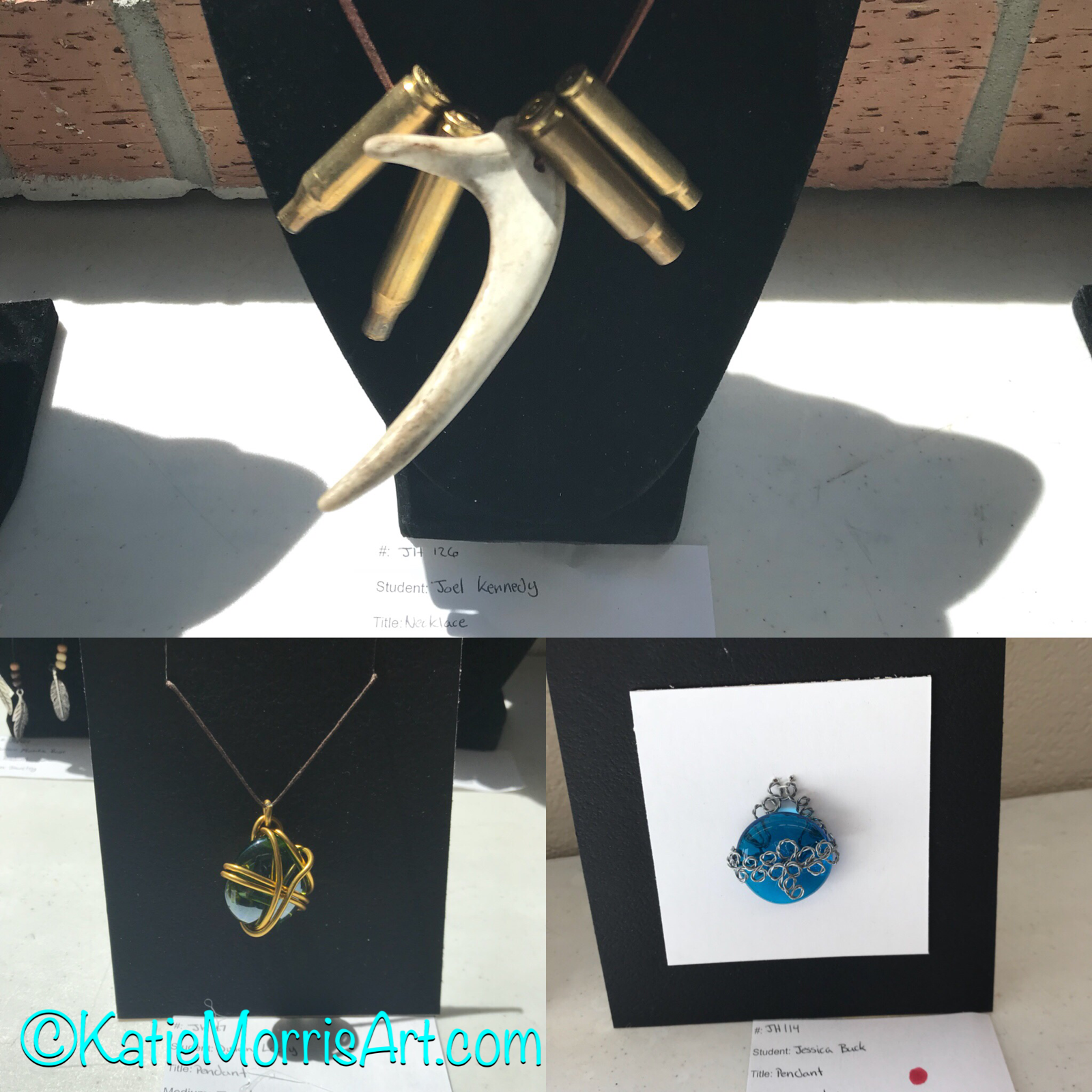
This student wanted to make jewelry out of found objects. She started with forks and ended up exploring nontraditional jewelry the whole time.

She got scraps of glass from our local hot glass shop and fused them before making a wire wrapped necklace inspired by Alexander Calder.
This student used fabric scraps to create an abstracted kite piece.


This was the unit where I saw the most exploration from my students. Some didn’t have a finished product and others had multiple. Since I grade mostly based on the Artistic Thinking Process that worked out just fine!

Sunday, March 3, 2019

High School Jewelry

It seems like the month of March can make for tricky lwssonnplanning. We have a full week off for spring break and one or two days off for in-service and parent teacher conferences. It is challenging to get a big project completed during that month sonoast year I broke away from a theme and did more of a bootcamp/workshop approach. I very rarely have students create jewelry but I thought they would be interested if I gave them time to explore it. 
I showed the students a slides presentation with different categories of jewelry that would be possible- wire, wire and beads, leather, aluminum, found objects. We had recently discussed jewelry as art (https://docs.google.com/presentation/d/1BrtuXYWIzt03fEHLxJAeAeCXPUuPW7lcnRotYpBkTb8) so we built on that. Here is the presentation with inspiration for different techniques:

I turned one section of countertop into a buffet with all of the materials we had available. A student taught me how to use a river gun and that was pretty fun, though not utilized by the students much. The second week I introduced some sculpture prompts but almost every student wanted to continue working on jewelry. The students combined techniques, brought studs in from home, uses tools in the Ag shop to cut and grind materials, and were just super engaged. 
We ended up taking several pieces of jewelry  to our league art show And came home with a few medals, even to a couple students who would not describe themselves as artists so that was pretty fun. 
I had intended to either do jewelry or raku during March this year but we are so behind due to snow days that most students will need the time to finish their February projects. 
Here are some pictures of the jewelry we took to league last spring. Enjoy!


Saturday, November 11, 2017

Theme: Story

STORY was one of my favorite themes from last school year. We got some really cool artwork out of the theme and it was broad enough that there was lots of room for different interpretations and the students' interests.

After the introduction, I asked students to research a myth or legend that they were unfamiliar with and write a paragraph summary just to get them thinking about new possibilities. A few students used the research for their projects and the rest moved on with other ideas.

I didn't do a printmaking bootcamp but offered demos when students were trying to come up with something new to try. These two prints were both inspired by a myth or legend.

Clay was a popular choice during this unit. Some students fired and glazed and others added in different materials such as moss, stones, sticks, and glass.
This student made a hobbit hole.
This was kind of like a fairy cottage. It was super cool.
This was one of my advanced students last year. She found an old story she had written and created a box from the story. It even has her own language carved into the side.
These students chose stories that are movies but did a good job moving past copying a movie cover.
I love looking around and seeing all the variety in the classroom!

This student joined the class at semester so made basically her first painting for the project using water soluble oil paints- not a fan of the medium, by the way, regular oils are SO much better- and she worked to get lots of information from the story into one composition.
This was inspired by a song I think called Granddaddy's Gun or something like that. The student incorporated small copies of family pictures of them hunting together on the drawn mantle.


Saturday, March 18, 2017

Community and TAB-ish art history

Last summer as part of my graduate coursework, I took a class that was a survey of art history for educators. I LOVE art history, I minored in it at ESU, but I was a little nervous not knowing if we'd be expected to create lesson plans "in the style of" the artists we were learning about. Thankfully throughout my courses at UNK, I found that they had a real interest in letting the students make the program work for their lives- their teaching style, grade level, community, etc.


Throughout the course I tried to develop resources that I would actually use. I figured out how to incorporate art history into my TAB-ish classroom.


Our school mascot is a cobra. 
One unit that inspired an idea was American Regionalism. I always try to boil art history down into the big idea. Regionalist artists were basically painting pictures that represented the people, places, and stories of their communities. Today's communities, even in the midwest where Regionalism was rooted, look much different than in Grant Wood's, Thomas Hart Benton's, and John Steuart Curry's day. Technology and social media have changed how we connect. I wondered how my students would define their communities.


I've been using a mixture of boot camps and themes for my main high school art class. On the day we were due for a new theme, I started off with a slides presentation about Regionalism.


We discussed the slides, discussed the idea of community and how it doesn't have to be a physical community, before brainstorming communities that the students are a part of and figuring out how they wanted to represent the idea of community in a work of art. Some students chose our school as a community, several represented teams or organizations, some used farming or hunting, some chose online communities, some even represented serving the community in the military. The ideas were vast and so were the media the students chose to carry out their ideas.

This student made a rural scene which fits our community but filled in the space with binary code to represent himself.

Two designs with the same composition and colors (our school colors) reversed were woven together to represent our school having a lot of different types of people but we're all one community. Made by a student with some special needs.

Our school has very successful running programs and the students talk about the feel of family and community there. I wish I'd planned for more time on this project. The painting of the team on the top right would have been much improved if the student wasn't rushed to finish before the end of the semester.

Godspell was our school musical last fall so it made an appearance in a couple projects.
This student works at a veterinary office as a kennel tech and represented her job as part of her community.

This was supposed to be a church picnic but the student ran out of time and had to eliminate more of the crowd. 

Representation of the style and sense of humor of this students' community of friends.

Artist Statement: I decided to represent the farming community through the burning of CRP/Grassland. I choose this topic because I grew up in a farming community. Also, I have had experience in burning CRP. In my art I painted the grass being burned, sparks flew through the air and into the fire, and the fire was fully ablaze. I had trees in the background that were about to be caught on fire. Finally, behind the fire I have the burnt pieces of grass that have already been through the fire.
The two students above used their after school jobs as part of their community project.
Artist Statement: I did, for my community project, a couch with four people people, one a Death Eater (from Harry Potter), one a Science Officer (from Star Trek), one a X-wing Pilot (from Star Wars), and a Superhero (The Flash, from DC comics). I represented the Nerd community by putting these four together. I chose this topic because I am very big in this community. I visually represented this by putting them all hanging out together on a couch, in one of their houses. The title also represents the community by being the thing that starts every Simpsons’ episode ever (Couch Gags).

One of my freshmen loves wheel throwing and is pretty good at it. She has a large family that represents community to her so she made a bowl to represent each member of her family.


I think this theme will be added to my rotation. I teach in a small school so my class "regular" art class is like an Art 1, but students can take it more than once so I may have a senior with 4 years of art under their belt and a freshman who hasn't had art since elementary school in the same class. I think I will have to figure out a rotation of themes or some other method to allow students to propose their own theme. My advanced art class has been a full-TAB experiment this year. I'm still finding the right balance for my students.

Thursday, January 12, 2017

Unsung Heroes


I heard about the Unsung Heroes art competition from a former colleague (featured in the video above) and thought it sounded like an awesome project. I decided to use "Heroes" as the first themed project for my high school graphic design class. Some students have taken the class 4 times and it's a first for others. The students could choose any medium to communicate their idea.
We started with a discussion of what a hero is and watched the videos from the Lowell Milken Center. Next, I asked students to brainstorm and research to choose a hero. They could choose a hero from the LMC website that would be pre-approved for entering the contest, they could find their own unsung hero from history and seek approval for entering the contest, or they could just focus on a hero without the contest. I had a few students email to ask about a relative who had served in the military being their unsung hero only to be disappointed when they found out their person didn't meet all the criteria. I encouraged them to go with their choice anyway since I wanted the project to be meaningful to them and the contest part was just extra.
The students who chose personal heroes seemed more engaged in their projects overall than those who chose from the Unsung Heroes list, so I'm glad that I didn't limit them to participating in the contest. The contest is an amazing opportunity with a great message and the largest monetary prize packages I've ever seen in a middle and high school art contest so don't let that deter you! It seemed that most of the students who chose from the Unsung Heroes list did so randomly just to meet the requirement where the students who did their own research or chose a family member did it because they cared.
Will I reuse this theme in the future? Possibly, but I will probably not do it as the first theme for a class, or would instead offer it to my advanced students. The project does not have to be a portrait, but it is helpful, and many students were intimidated. I decided to let some trace the contours of a portrait of their unsung hero with the agreement that they would add more to it, and I wish I wouldn't have. There's not necessarily a problem with tracing- lots of contemporary artists do it instead of a grid method and it's not that different from Renaissance artists supposedly using a camera obscura- but I typically don't let students do it unless it is a photo that they took. Tracing has now been a hard habit to break for those students. Some saw tracing as the default and totally forgot about drawing but I think we're back on track now.
For my unsung heroes project I used my grandpa. He fought in Vietnam and saved many men. He disobeyed his orders and flew into a hot zone and rescued a bunch of men. He deserves recognition because he is a very humble and amazing person. I used pencils, colored pencils, and sharpies to create my artwork. I drew a chinook to show that’s what he flew to rescue the men, I then drew a picture of him in uniform, an American flag because ‘Merica, the 82nd and 101st airborne symbols because that was what he was in, and lastly I drew his dog tags. My grandpa is one amazing, humbled, loving, and caring man you will ever meet. For these reasons is why I used my grandpa for this unsung heroes project.
Today many women participate in the Boston Marathon, in but 1967 that wasn’t the case. Over history, there are people who stand out and make a courageous move to be the first one to do something. Kathrine Switzer was the first women to run the Boston Marathon. I chose Kathrine Switzer for my unsung heroes project because she is a light illuminating in the darkness. She shows society that just because you are a woman, that doesn’t mean that you can’t do things that men are doing, such as running a marathon. Also she is a great example in what it means to have determination and drive. During the race, officials tried to pull her out of the race but she wouldn’t give up. I was interested in Kathrine Switzer’s story and I could relate to it well because I’m a runner. Whenever you have passion and interest in what you are doing, it just makes your work all the more better. Kathrine Switzer is a hero to me because she was unique and original. She didn’t go where the path led, but instead she went where there was no path and left a trail. The whole story about how she started running and then realized that she could be capable of running a marathon is inspiring. It reminds everyone that knows her story, that the most dangerous place is in your comfort zone. Kathrine Switzer definitely deserves recognition for her amazing accomplishment of being the first woman ever to run the Boston Marathon.

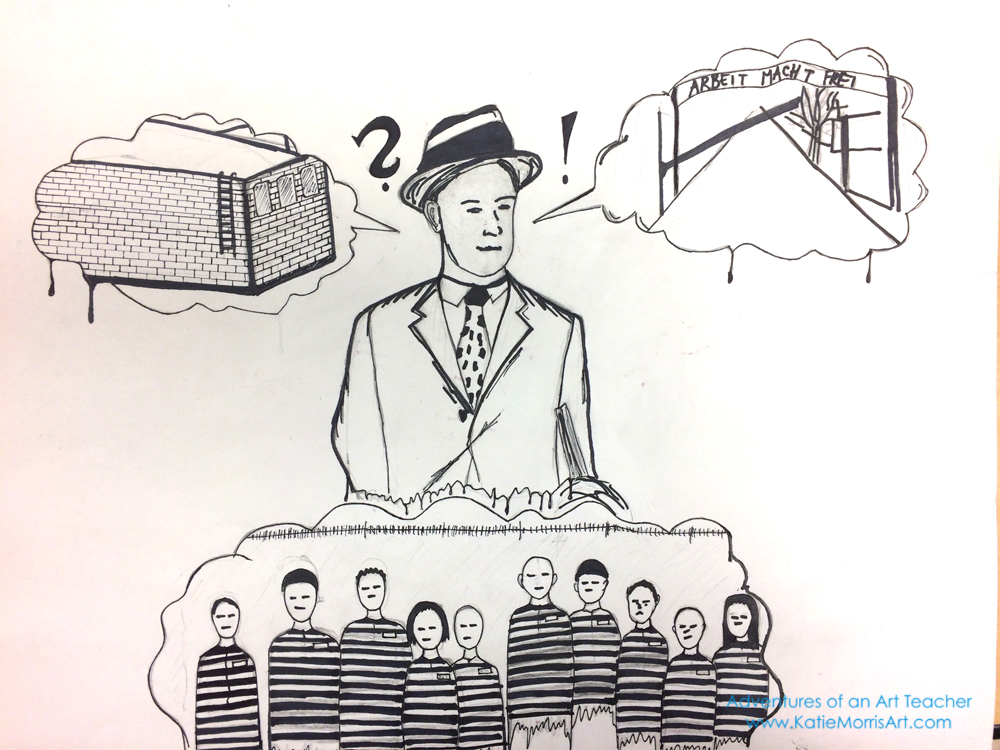
When you think of heroes on 9/11, who do you think of? Firefighters? Policemen? First responders? What if I told you that one of the men who saved the most lives on 9/11 was none of those things. My graphite drawing represents Benjamin Clark. Clark was a chef on the 96th floor of the South World Trade Center Tower. He started his day as he always did on that tragic September day. But when the events unraveled, Clark went into action saving all the people on his floor, saving over hundreds of lives as he worked his way down the tower. Clark died when he stopped to assist a woman stuck in a wheelchair. Clark could have made it out alive along with the men and women that he saved. That would have been courageous enough but instead he stayed to assist someone who would have died without a chance. That is why he is a hero. I chose to do a graphite drawing to show Clark’s story. I drew a portrait of him in the foreground and the burning twin towers with the smoke spelling out “Clark.”