Showing posts with label Duck Stamp. Show all posts

Monday, April 13, 2015

2015 Kansas Jr. Duck Stamp Program

6th grade Wood Duck that received an HM
It was another successful year for my students in the Kansas Jr. Duck Stamp Contest! This is an annual project for my students, and students of the other elementary art teachers in my district. The Federal Jr. Duck Stamp program teaches students about conservation of wetland habitats and waterfowl through making art. It is also a great way to practice observational drawing skills and gives students a chance to compete with their artwork. I always encourage students to enter even if they don't think they'll win because it helps ducks! (Funding for each state's JDS program is based on the number of entries they receive.) I've been a fan of the program ever since I participated for the first time as a freshman in high school and always knew I would teach it to my students. You can see previous posts with more information about the Jr. Duck Stamp program HERE or you can visit www.fws.gov/juniorduck. If you have any questions about the program, feel free to ask! I got to travel to Utah a few years ago as an ambassador for the program and I had the chance to learn even more about Jr. Duck Stamps and the "adult" Duck Stamps.
Here, a student demonstrates proper use of a reference photo. They changed the positioning of the duck and changed the background to put it in a wetland habitat.
We had several students earn Honorable Mentions in Group I (K-3rd) and Group II (4th-6th) and one 1st grader even received 2nd place. 
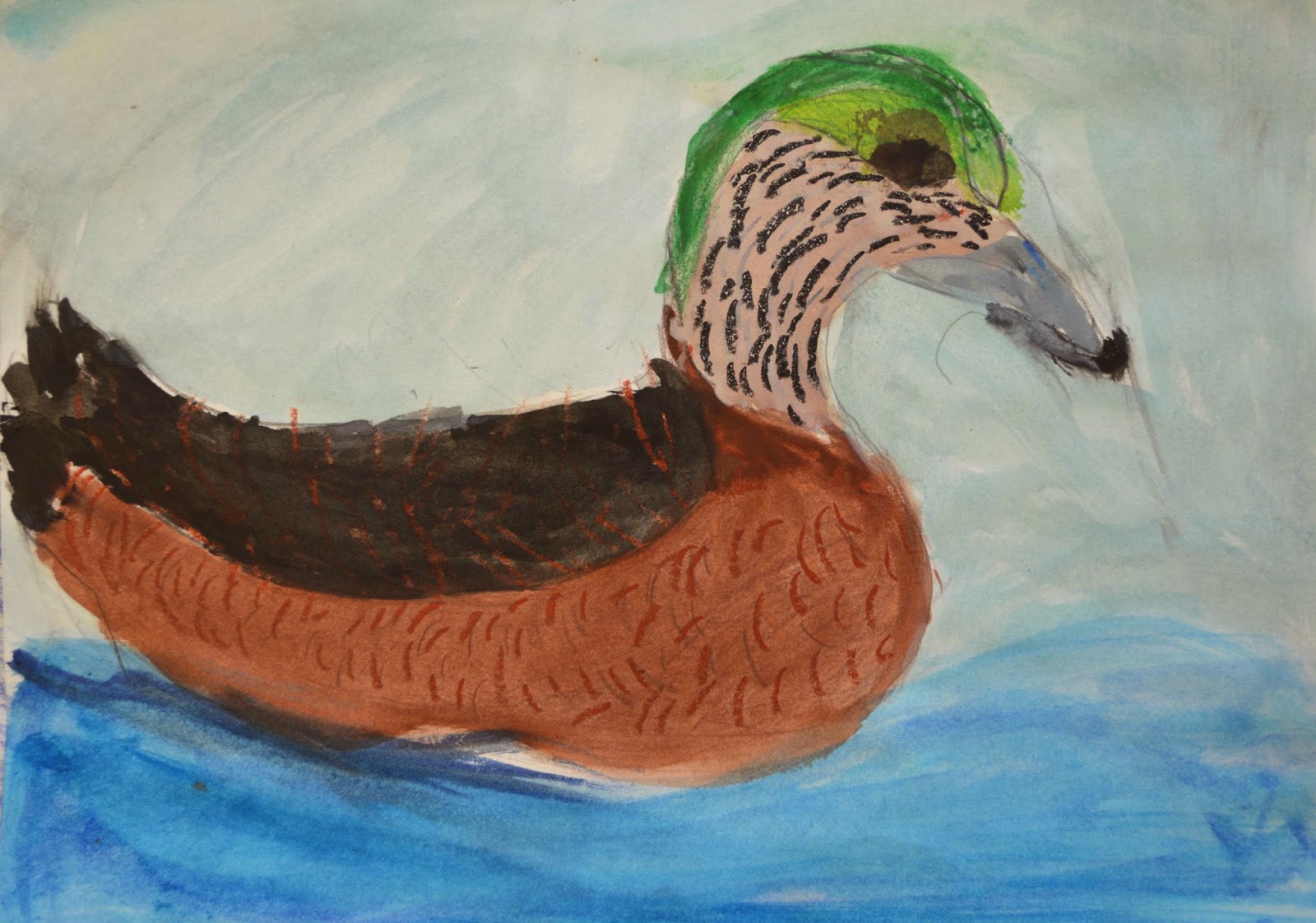
The student who painted this duck was upset to the point of tears while working on her project. The watercolors bled and she thought it was ruined, she was a horrible artist, she couldn't do it, etc., etc. I said "No, look how beautiful the colors are when they mix!" and we fixed the eye in the next class. I was pleased when she was recognized for her work after temporarily deeming it a failure.
Except for the wood duck at the top of the post, the previous entries were by primary students. The next set are by the intermediate students.
This 5th grader drew his wood duck too small the first time- see the duck in the back. We enlarged it on the copier and he traced it again in the foreground so it looks like two ducks, improving the composition.
Here are a couple more duck pictures I didn't want to leave out:

Sunday, October 7, 2012

Federal Duck Stamp Judging

At the end of September, I was able to travel to Ogden, Utah to attend a workshop and the Federal Duck Stamp judging as a Jr. Duck Stamp Ambassador. Until I became an official ambassador, I didn't realize just how many people don't know about Duck Stamps!

Here are some Duck Stamp facts 
  • The legal name for a Duck Stamps is Federal Migratory Bird Hunting and Conservation Stamp.
  • The first Duck Stamp was released in 1934 and was designed by J. N. "Ding" Darling.
  • Duck Stamps have been one of if not the most popular and successful conservation programs in US history. 
  • 98 cents of every dollar paid for Duck Stamps goes to purchase or lease wetlands for protection in the National Wildlife Refuge System.
  • Since the program's inception, more than $750 million has been raised and used to secure over 6 million acres of wetlands habitat.
  • Duck Stamps are not just for hunters, though they are the largest group to purchase them. Duck Stamps are for anyone who cares about habitat conservation, birds, or awesome art on stamps.
  • Only a few species are allowed for the contest each year.
  • Artwork is chosen based on Aesthetics, Biology/Anatomy, Habitat (appropriate for bird, does the season match the plumage, etc.), and Design (will it work well for a stamp?)

You can read much, much more at www.FWS.gov/DuckStamps

You may be wondering how I come into the picture... I learned about the Jr. Duck Stamp program, which is modeled after Federal Duck Stamps and strives to teach youth about conservation through the Arts, as a high school student. When I took my first ever Art class as a freshman in high school, participating in the Jr. Duck Stamp program was a requirement. The next three years, I participated out of choice, because I enjoyed it so much, and developed a love for waterfowl.  I grew up in a "sporting" family around lots of hunting, fishing, and trapping. I could see the value of the Jr. Duck Stamp program and know that Conservation is very important. I started teaching my students about Duck Stamps from the beginning of my career and try to teach others about them as well. This led the Kansas coordinator for the Jr. Duck Stamp program to recommend me as an Ambassador. Jr. Duck Stamp Ambassadors are a new thing. FWS Region 6 was hosting the Federal Duck Stamp contest this year and decided it was a good time to try. I feel so honored to have had this opportunity and hope I can help get other teachers (or parents, or scout leaders, etc.) involved.

The first day of our workshop involved touring the Bear River Migratory Bird Refuge (which I wrote about here) and a little reception in the evening with all the FWS people, judges (though we didn't know who they were until the day of judging), and ambassadors. The second day was round 1 of judging, Ambassador discussion time, and a talk by two of the Birds in Focus photographers. The third day was the final rounds of judging, more workshop time, and more awesome food. The judging was INTENSE!
 
All the 192 entries were displayed in one of the ballrooms before the beginning of Round 1 and were replaced as they were eliminated. Here are some observers checking out the artwork. 
Here is one of my favorites. 
There were a LOT of students and teachers attending Day 1 of the judging. Here is a class looking at all of the Jr. Duck Stamp winners from across the US. Part of our job was to talk to the students and teachers attending and pass out the purple bags you'll notice the teacher above holding, filled with paper, art supplies, and information on the Jr. Duck Stamp program.
Round 1 was pretty brutal. Here you can see the 5 judges (who are highly qualified and represent wildlife photographers, biologists, and stamp experts) voting "In" or "Out" on one of the entries. The judges have dividers between them so they are not influenced by anyone else. There was a small screen  in front of each judge that I'm assuming had a picture of the artwork. Volunteers walked the artwork across the stage so the judges could see the original before voting. All 192 entries were voted on in this fashion during Round 1. I think the 192 was narrowed down to 60, then 7 more were brought back for a total of 7. After Round 1, each judge has the power to bring back up to 5 eliminated entries that they feel deserve more consideration.
In Round 2, starting the next morning, the judges give each of the remaining entries a score of 1-5, 5 being the best. At the end of Round 2, all of the entries with the 5 highest scores move on to Round 3. Voting in Round 3 is carried out in the same score 1-5 method. At the end of Round 3, we had a first place winner, but a tie for 2nd.
 Round 4 was the tie breaker. The volunteers above were showing the judges the two pieces tied for 2nd place, side by side. A final 1-5 vote was taken and the winners were announced!
The winner, which will be reproduced on the 2013 Federal Duck Stamp to be released next June, was a common goldeneye created by San Francisco artist, Robert Steiner.
Here I am standing by the 1st, 2nd, and 3rd place entries. (Shhh- I like the 3rd place entry better than the 2nd!)
And above we have Mel (FWS Biologist), Bobbie (JDS Ambassador from Wyoming), Emily (JDS Ambassador from Kansas), Beverly (FWS), me, Jane (JDS Ambassador from North Dakota), and Bruce (JDS Ambassador representing South Dakota.)

If you are interested in learning more about the Jr. Duck Stamp program, please don't hesitate to contact me or check out the Jr. Duck Stamp website. This is a K-12 program that can be taught at school, at home, or in other groups like Scouts or 4H. The new curriculum guides have been redesigned to better reflect national standards across Science and Art.

Tuesday, January 26, 2010

(Kansas) Jr. Duck Stamp Program

I am all about ducks.  I first learned about the Jr. Duck Stamp program when I was a freshman in high school.  I wish I had known about the contest when I was younger because I definitely would have participated!  I only had it as an assignment in 9th grade but I enjoyed it so much that I elected to make a drawing for the contest in each of my remaining high school years.  (Photos of my duck drawings at end of post!)

Duck stamps have been around since 1934 with the first duck stamps designed by J. N. "Ding" Darling. Waterfowl hunters aged 16 or older are required to purchase a duck stamp.  The stamps cost $15 and 98 cents out of every dollar is used to either purchase or lease wetlands which become protected by the National Wildlife Refuge System.  Since the beginning of the program, more than $750 million have been raised to conserve over 5.3 million acres of wetlands.  (Questions about Duck Stamps?)


The Jr. Duck Stamp Program started in 1989 as an educational program with the goal of teaching "Conservation through the Arts."  Artwork created for the program must be 9x12 inches and in a horizontal format.  There can be no writing on the front of the artwork and the artwork should realistically represent a bird species from the list of eligible ducks, geese, and swans.  Each state has a contest with four age groups, the Best in Show is sent on to the national competition.  Click here for info on how to participate in the Jr. Duck Stamp Program or here to find information specific to your state.

I am so excited to have the opportunity to do the program with my students.  My 1-3 students are all finishing their duck drawings and my 4-6 students have the choice or birds or bugs (for Kansas Critters: Bugs.)

Here is my Jr. Duck Stamp Program Motivation Kit List!

  • Real duck stamps- My dad saves his old duck stamps for me.  I have one that was on his hunting license from a couple years ago and the students were really excited about it.
  • Jr. Duck Stamp Poster- If you can get ahold of one!
  • Feathers- I recently added some feathers to my bulletin board display, the curled feathers from a mallard's tail.  Students very excited, of course.
  • Examples- I brought my high school JDS drawings and a duck drawing from a couple months ago.  I showed each drawing and talked about the different duck species I drew which got the students excited.
  • Reference photos- the guidelines for what reference photos can be used are getting a bit stricter as an attempt to teach students about copyright and plagiarism.  About 90% of the photos I put out as reference are photos that I have taken of ducks and geese at zoos, parks, and the wetlands near the school where I student taught.  I have a couple of photos from a calendar and pictures of decoys as well.  I talked to the students about trying to get the shape and markings accurate but changing the background.  I told them as long as the background was an appropriate habitat for the bird, it would work in their drawing.  (I think that middle and high school students have to cite their source photos now.)

Freshman Year- Harlequin Ducks

Sophomore Year- Hen Mallard

Junior Year- Canada Geese

Senior Year- Fulvous Whistling Duck

Saturday, January 16, 2010

Follow the Leader Duck or Goose Drawing

Right now my 4-6th grade students are working on either the Jr. Duck Stamp program or a drawing for Kansas Critters: Bugs.  All of my 1-3rd grade students are working on Duck Stamp drawings.  After talking to the other elementary art teachers in my district, I decided to do a follow the leader drawing with my Kindergarten students to give them some confidence in their drawing abilities and good practice for Duck Stamp drawings next year.

I let each class vote on learning to draw either a Mallard Duck or a Canada Goose.  I taped a large piece of paper to the wall where all the students could see and used a sharpie for my drawing.  Each student was given a 9x6 inch piece of paper and a pencil to start with.  The papers were turned horizontally.  I always like to start with the head when I draw a duck or a goose and encourage the students to do the same.  Of course when they are drawing totally on their own, a few will always start with the feet and run out of room for the head.

After the outline of the bird, the beak/bill and eye, and a few lines were drawn for the wings and tail, I had the students put their pencils away and find one color of crayon at a time.  We all finished the body of the bird together with crayon to make them look realistic.  As realistic as Kindergarten drawings get anyway!

While I went around the room and wrote names on papers, I let the students add water or any other details they wanted to.

My philosophy of Art Education is still developing.  I try to give the students a lot of different experiences.  While part of me wants to just let them be free and make everything on their own, no limits to their creativity, I know that there are other skills I want to help them develop.  I guess I'm just trying to balance everything right now.  I want to help the students develop their observational skills and paying attention to details and I still give them as many opportunities for "free draw" as I can.
Daniel Pink was the Key Note Speaker at the Kansas Art Education Association fall conference this year.  Something he mentioned during his talk was that some universities have been taking their Med students to Art Museums where they discuss paintings to develop their observational skills.  I like to tell this to my students as a way to point out skills they learn in art class will serve them for the rest of their lives.